Blog
One in six U.S. counties actually welcome Data Centers in their community. Can the other 2,576 counties get to yes?

Read More
Blog
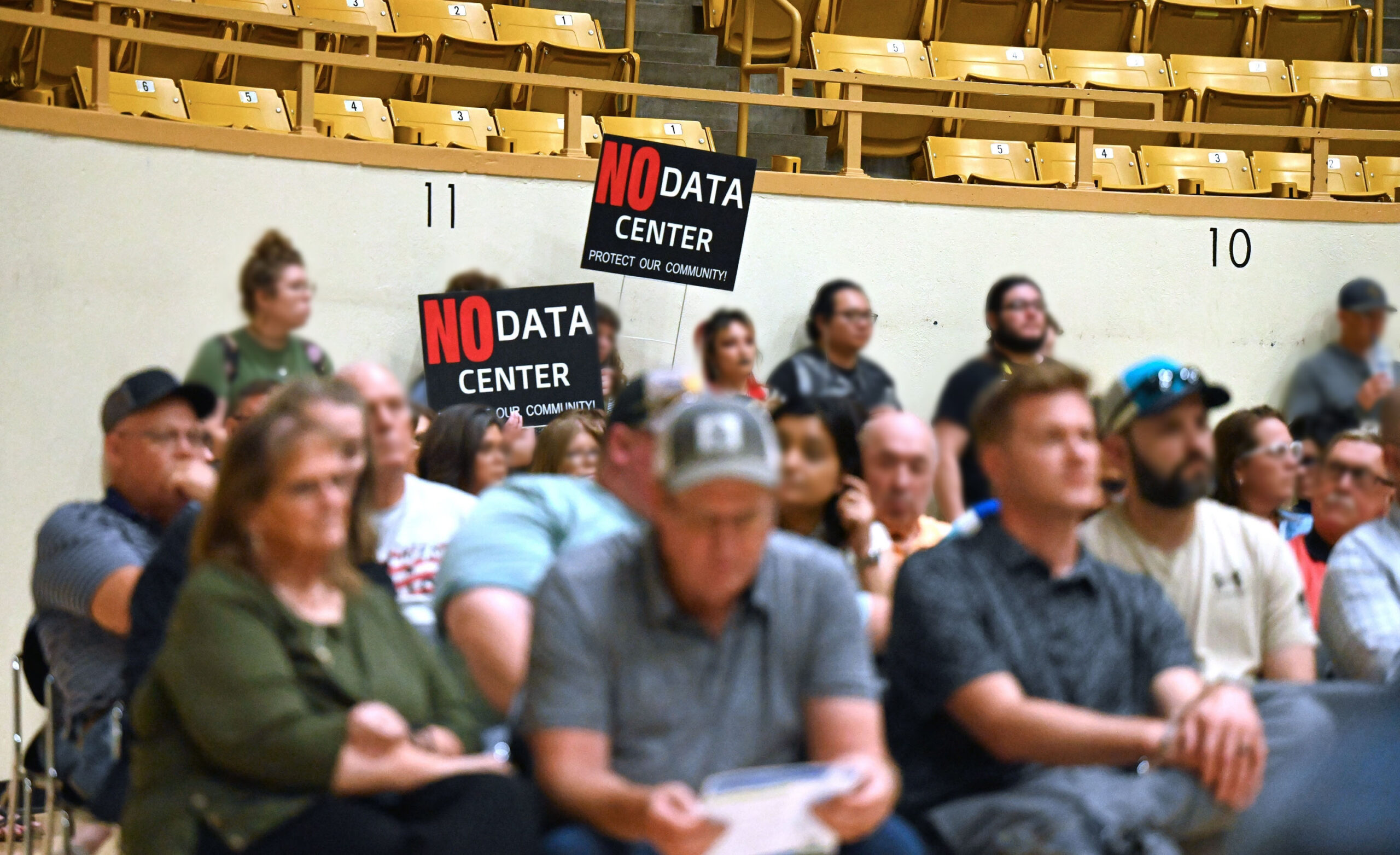
America’s data center buildout has hit a wall. Local opposition has torpedoed dozens of proposed projects, and roughly a hundred localities have adopted outright moratoriums. For the technology companies racing to add install capacity for AI and cloud computing, finding genuinely amenable locations has become existential.
So where should they look? Our first blog in this series found that the welcome mat is out already in about one in six U.S. counties. Our second blog identified the price of ‘getting to yes’ everywhere else.
This piece applies both lenses to one state at the center of the buildout: Iowa.
Iowa’s data center credentials are well established. Microsoft, Meta, Google, and Apple all operate major facilities there, drawn by cheap land, fiber, and abundant power. Beyond these locations, the question is where the next wave of facilities could win local support.
The answer: nearly half the state. Of Iowa’s 99 counties, 48 are already net supportive of building a data center in their community. Nationally, just 18% of counties clear that bar. Only Louisiana and North Dakota rank higher, making Iowa home to the largest concentration of welcoming counties among major farm states. And the support isn’t scattered at random. It runs in bands through the state’s rural northwest and north-central counties.
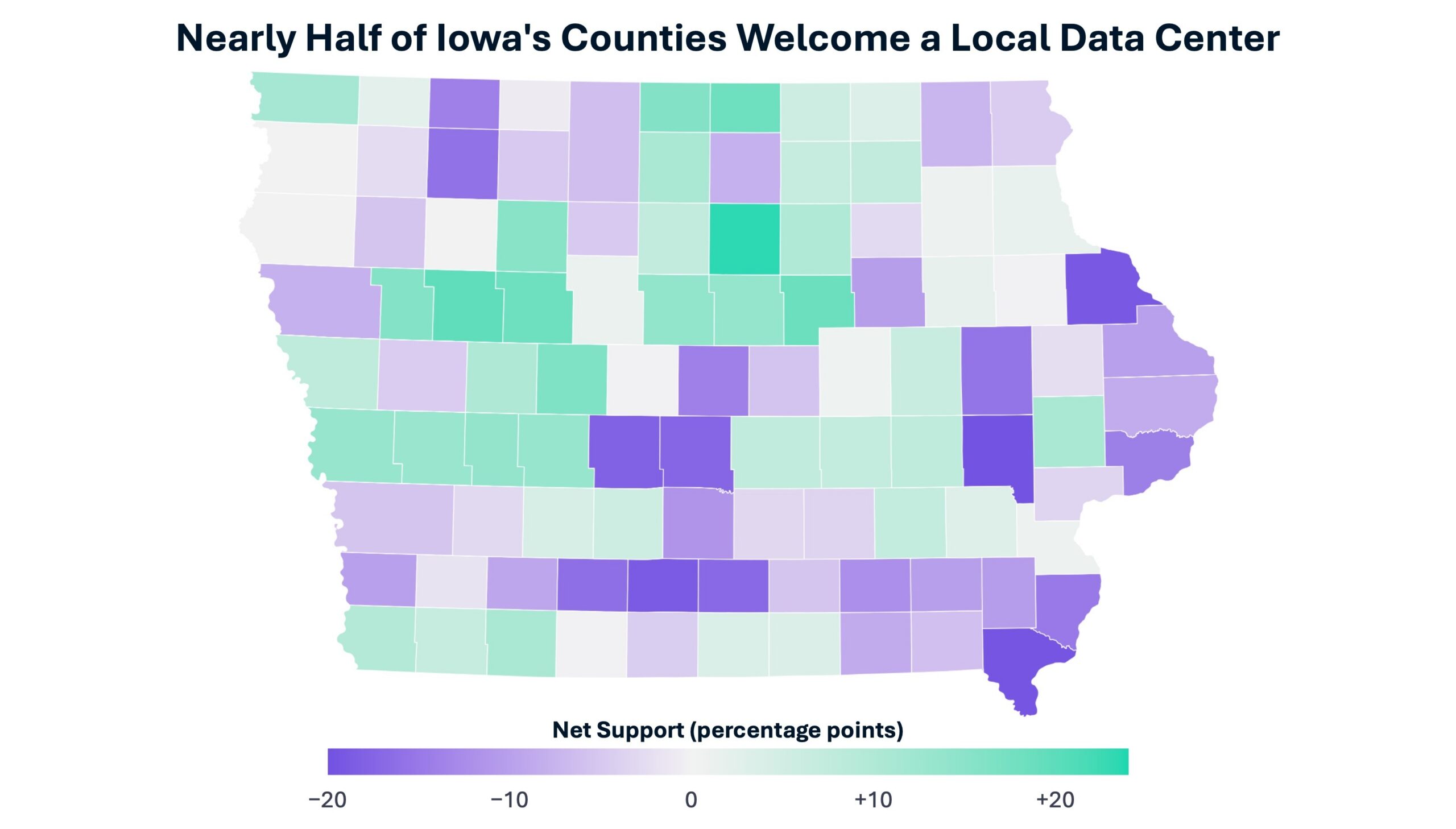
Source: Fraym data (July 2026) and analysis
Only 16% of adults oppose and say nothing would move them. And the super hardcore opposers – those who say nothing would move them and believe data centers shouldn’t be allowed anywhere – are just 9%. One American in eleven, not one in two.
Here’s the pattern underneath the map. The more agricultural the county, the warmer the welcome. Among the third of Iowa counties with the least farmland, 30% are net supportive. In the middle third, 52%. In the most agricultural third (counties where roughly 94% of the land is farmland), 64% are net supportive. Two of every three of Iowa’s most heavily farmed counties would welcome a local data center.
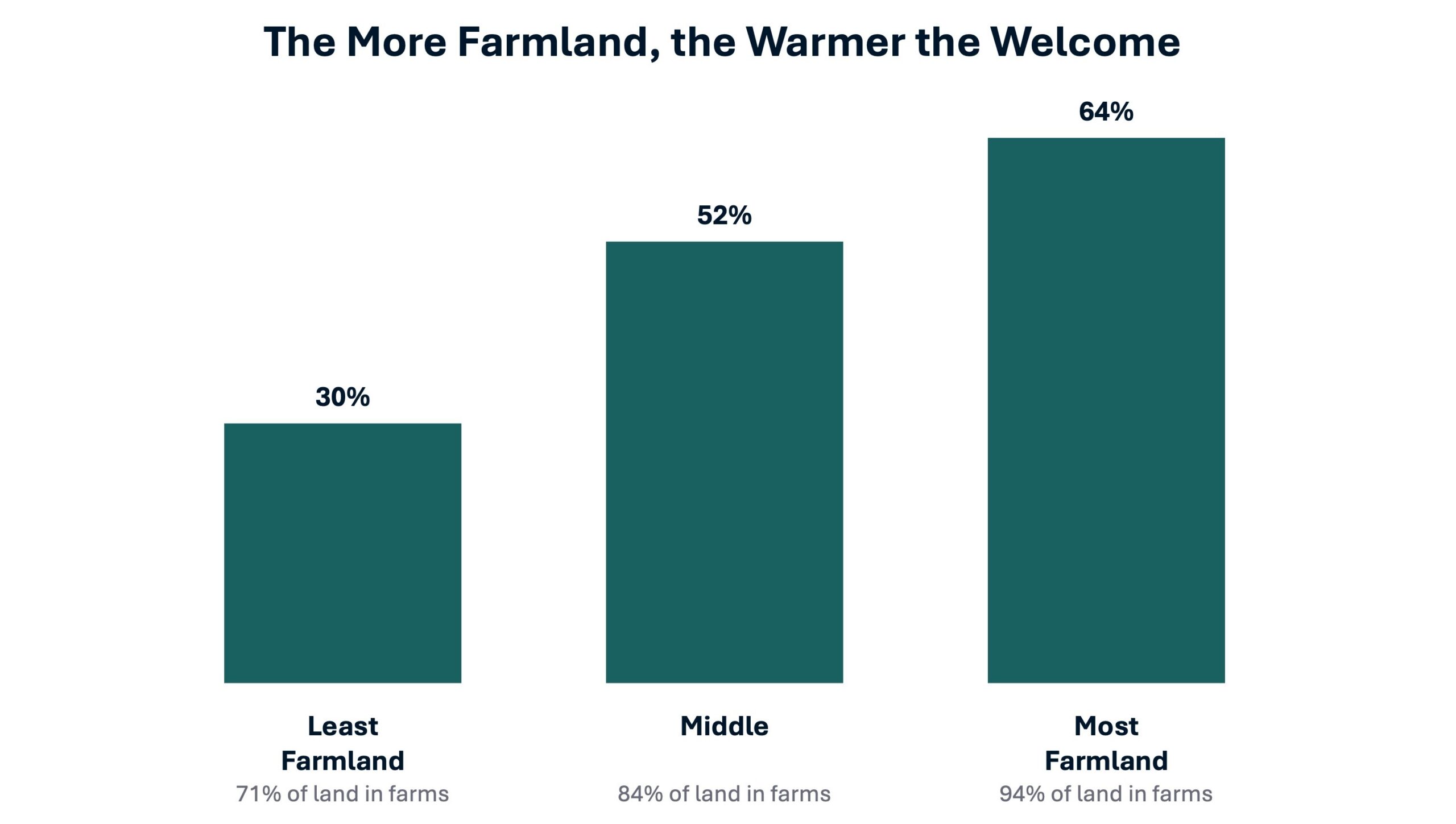
Fascinatingly, it’s not because farm counties worry less about losing farmland. Concern about farmland loss is essentially identical across all three groups, about 45% everywhere. These counties carry the same anxieties as the rest of the state, yet they reach a different conclusion.
That echoes a central finding in our first piece – what separates welcoming places isn’t the absence of worry. It’s a community’s judgment about what it stands to gain (or stop losing).
What about the 51 Iowa counties that remain net opposed? This is where the second piece’s playbook applies. Using the same conservative assumptions as before – i.e., only soft opponents can be moved and only with commitments they say would move them – 38 of those 51 counties are just one construction-related commitment away from solid majority support. And it’s the same commitment almost everywhere: a guarantee that residents’ utility bills won’t rise. Ten more counties need a package of two focused commitments. Only a handful of metro counties would require more than that.
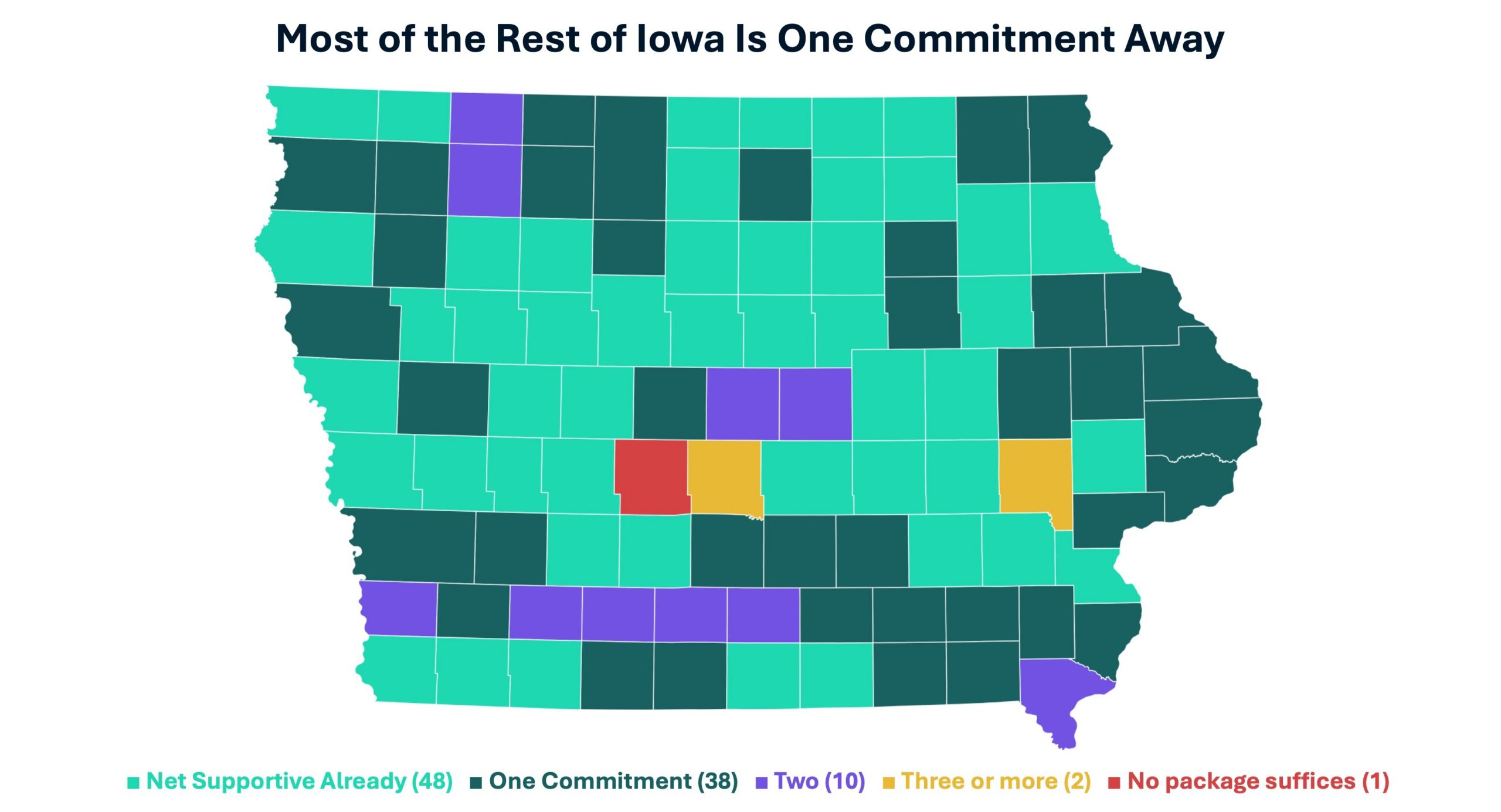
Put the two maps together and Iowa’s siting math is remarkable: 48 counties already welcoming and 38 more counties within reach of a single well‑chosen commitment. That’s 86 of 99 counties if technology companies prove willing to start by listening to local communities.
Here’s a shortlist of Iowa’s ten most welcoming places by net support levels: Franklin, Sac, Grundy, Calhoun, Worth, Greene, Winnebago, Ida, Pocahontas, and Hamilton counties. These counties share common attributes: they’re heavily agricultural, have fewer than 15,000 residents, and have net support as high as +23 percentage points. These are not places waiting to be convinced; they are places waiting to be asked.
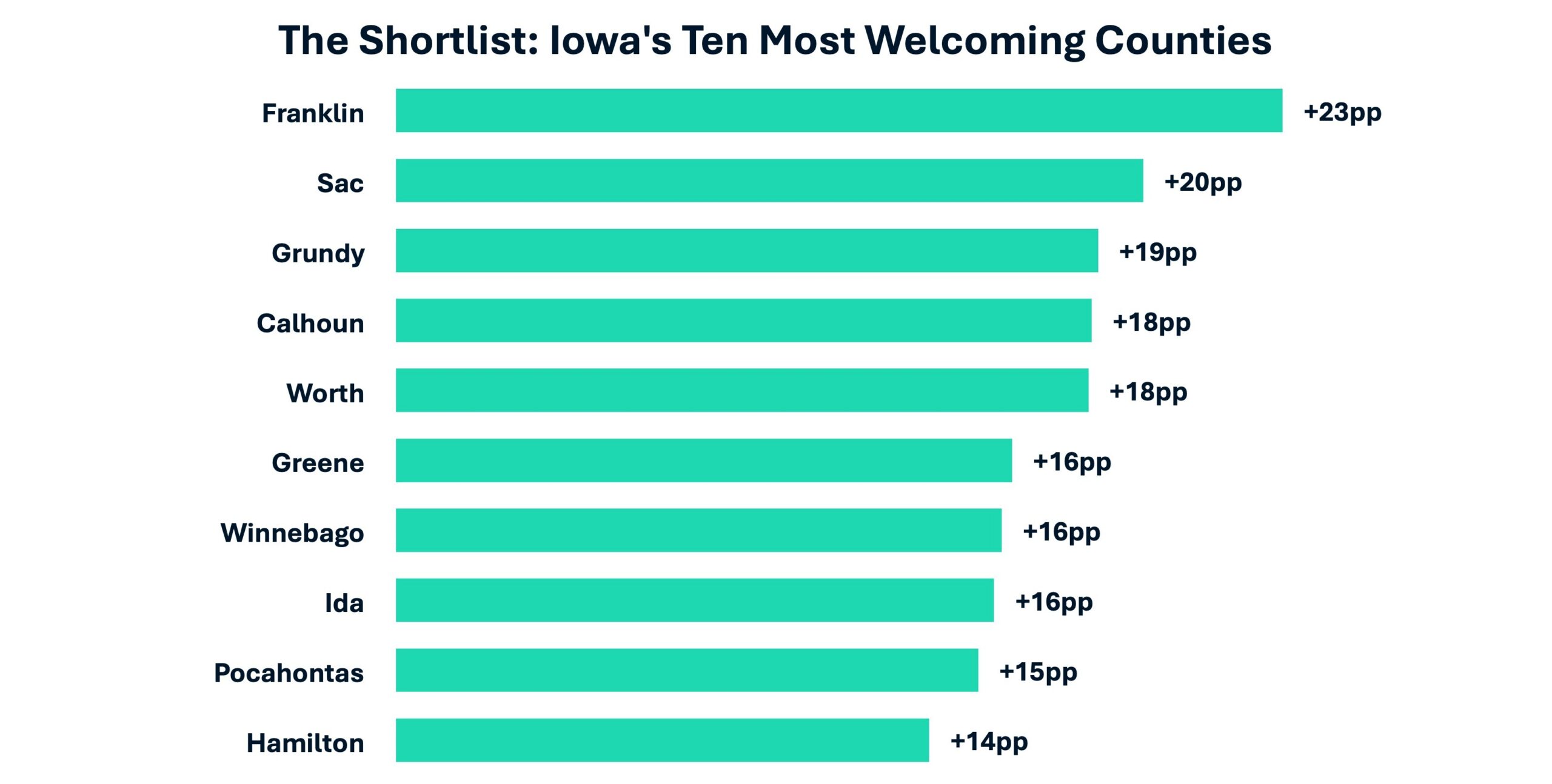
But tech leaders must also grasp a crucial nuance: public goodwill does not equal regulatory readiness. Because these rural counties rarely manage mega-projects, most lack off-the-shelf data center zoning. If an unannounced developer quietly buys land, local boards may panic and enact defensive moratoriums while scrambling to write rules. As we’ve seen in Ida, Grundy, Sac, and Greene counties.
So, rural Iowa isn’t plug-and-play. But if tech leaders show up early with explicit commitments on utility bills or water protection, then local communities’ strong net-positive support levels may convert into approvals.
Communities across the country are proving they can, and will, say no to local data centers. In Iowa, the path to “yes” seems much clearer. Technology companies just have to act first by listening to what residents are already saying and asking for.
Interested in tracking trends like these down to the census tract level across the U.S.? Contact Melissa Persaud at [email protected].