Blog
Mapping America’s Information Blind Spots

Read More
Blog
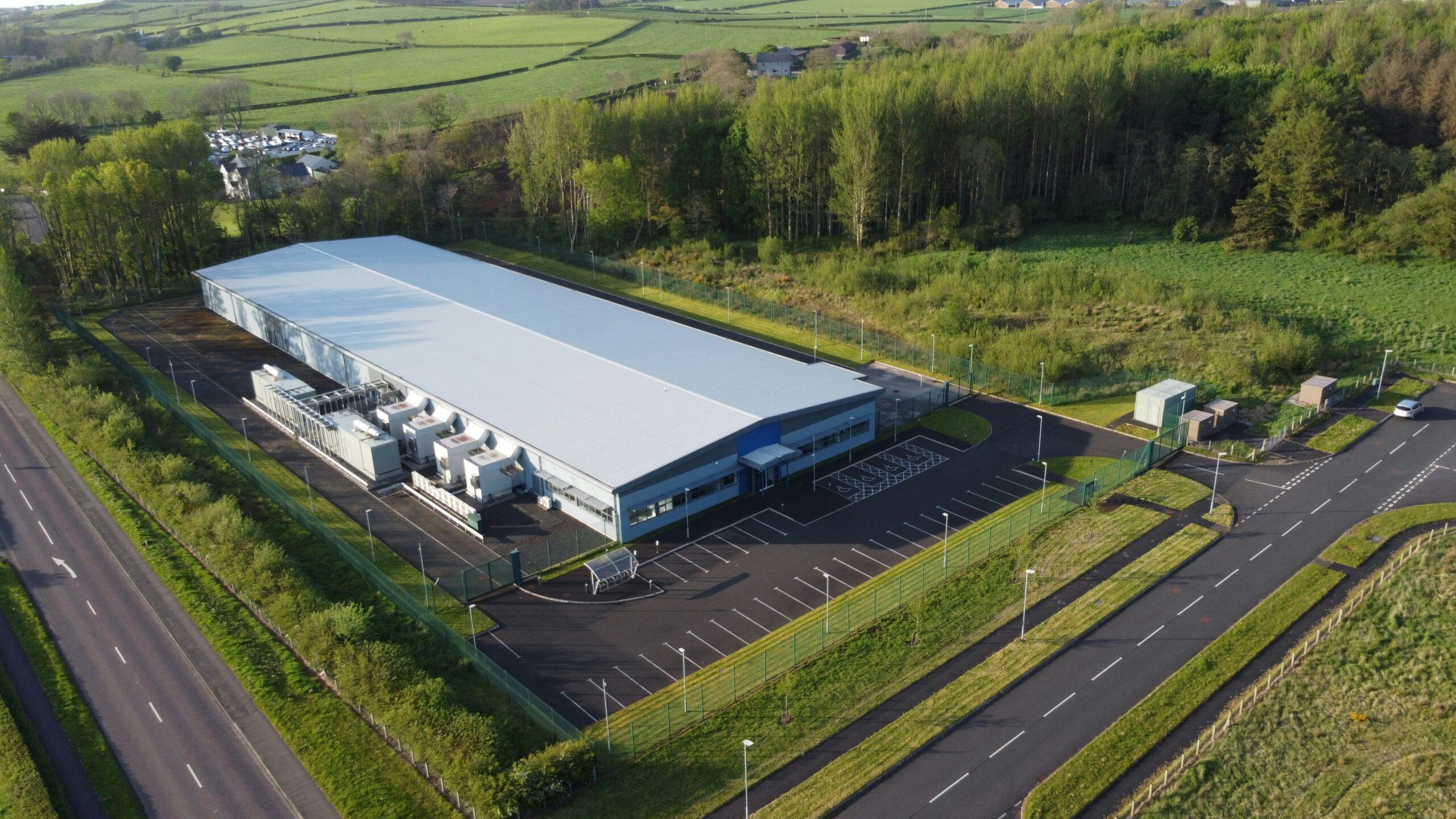
In 2025 alone, local opposition killed at least 25 major data center projects. The stakes are huge. We’re talking about $64 billion in planned capital that has been blocked or delayed by local pushback. While the engineering behind AI is advancing at light speed, the “human element” – local approval – remains the ultimate decider for projects. And, the playing field is tough with the county governments’ constituents. Nearly 96% of U.S. counties are net-pessimistic about AI – a figure that should give every hyperscaler some pause.
Each month, Fraym generates granular data on Americans’ attitudes about hundreds of topics down to the census-tract level. This includes tracking whether people believe AI presents more benefits or more risks to society. As of February 2026, the answer is stark: only 26% of Americans see net benefits, while 42% see net risks. The remainder think the benefits and risks wash.
Fraym created a simple index – the AI Optimism Index – to make tracking easy and intuitive for the entire country, including all 3,144 U.S. counties. This index represents the share of adults who see AI as more beneficial minus the share who see it as more risky. A positive score means people are net AI-optimistic, and a negative score means they’re net AI-pessimistic.
Nationally, the index score is -16 percentage points (pp). America clearly is very skeptical about AI.
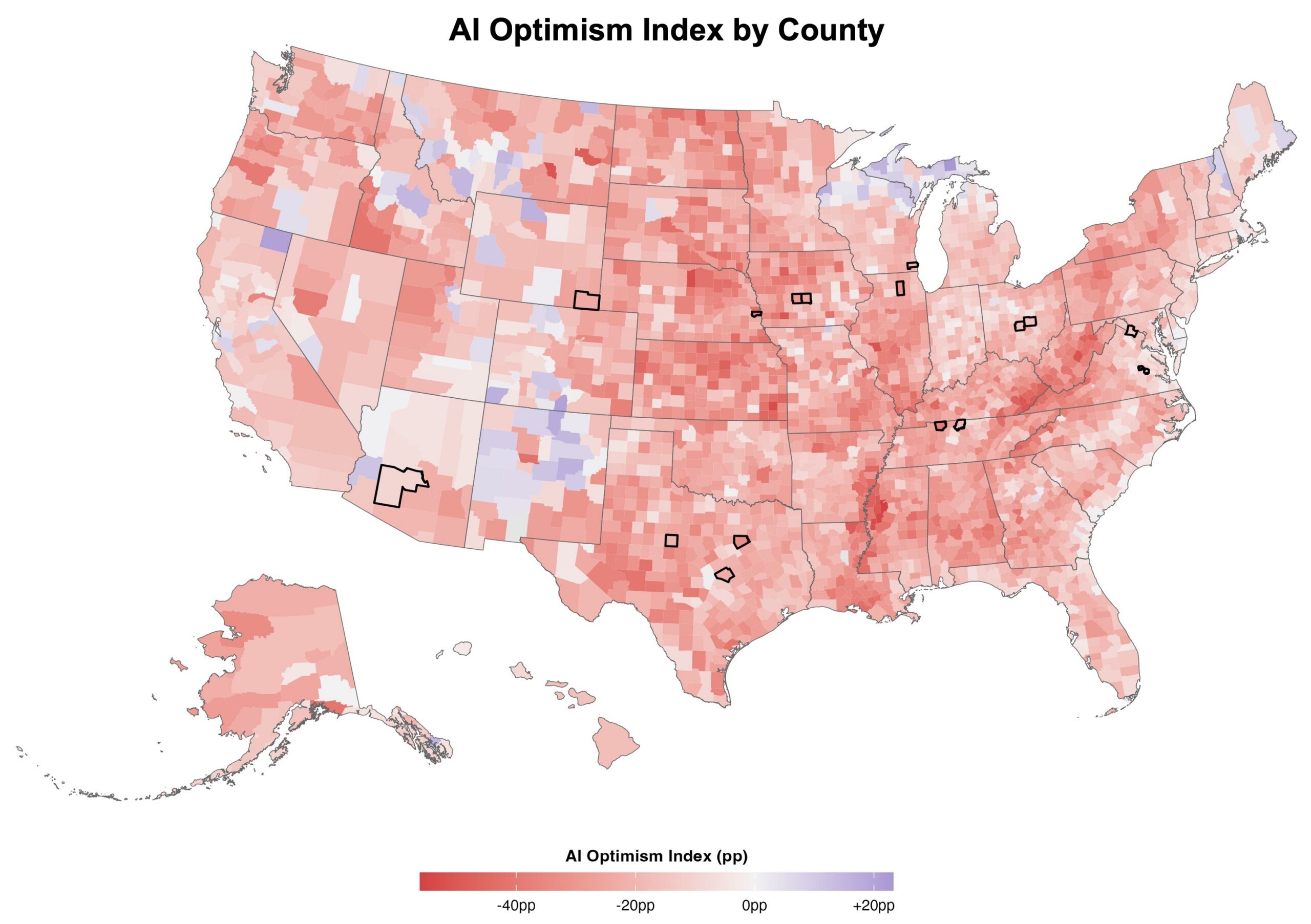
The most optimistic counties are exactly where you’d expect: San Francisco (+10 pp), Santa Clara (+8 pp), and Alameda (+5 pp) — the heart of the AI industry. The most pessimistic counties are concentrated in the rural South and Midwest, where scores fall below -50 pp.
But the more interesting question isn’t where Silicon Valley engineers are bullish on AI. It’s where the data center construction crews are heading — and what the communities there actually think.
We examined 18 counties where hyperscalers — Microsoft, Google, Meta, Amazon, and Apple — have large existing data centers or are building new ones. Four of these counties score above the national average, led by Henrico County, Virginia (-2 pp), where Meta has a facility, and Maricopa County, Arizona (-10 pp), home to multiple hyperscaler projects.
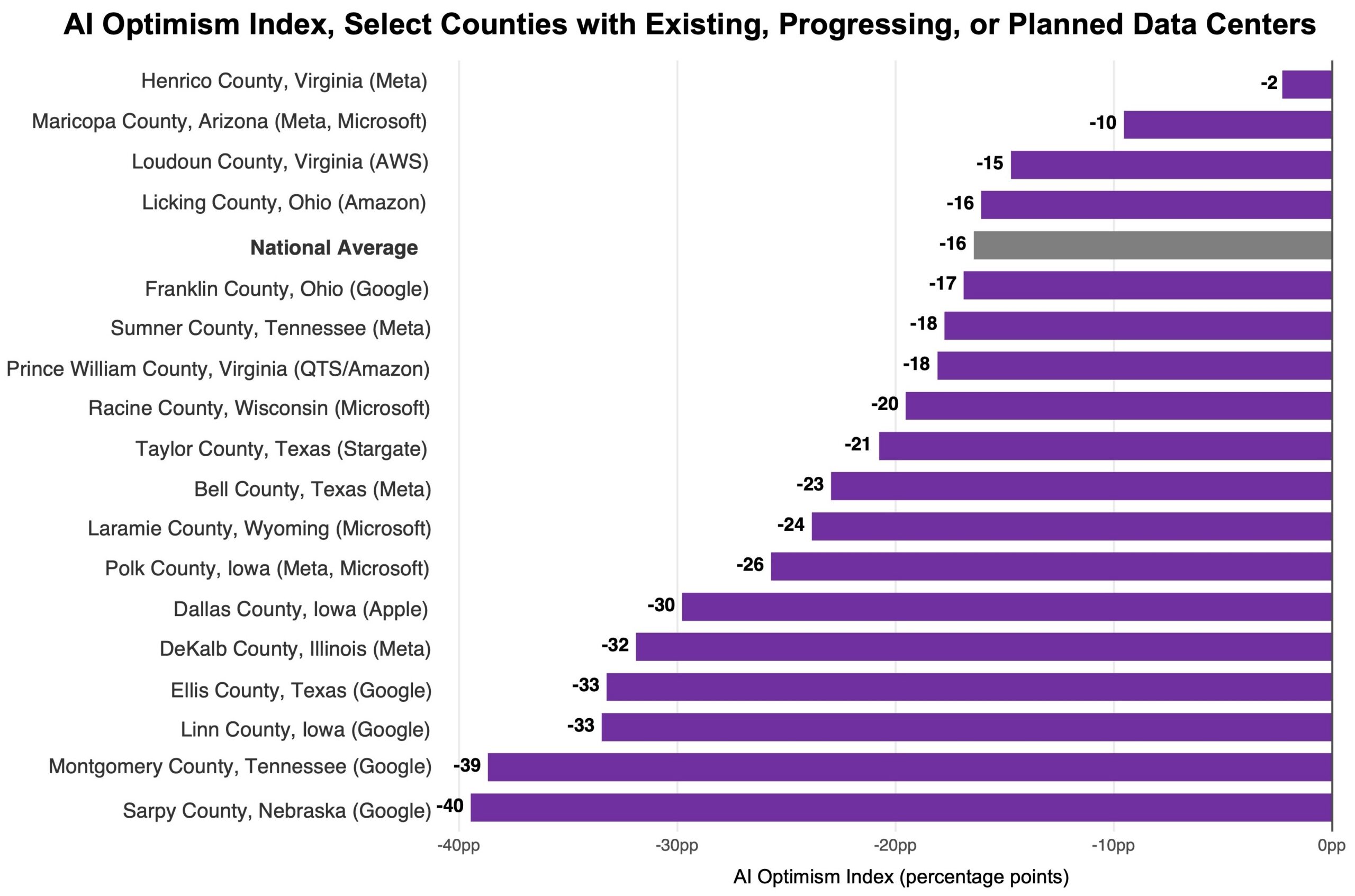
At the other end, Sarpy County, Nebraska (-40 pp) and Montgomery County, Tennessee (-39 pp) rank among the most AI-pessimistic counties. Google is the anchor tenant in both places. Taylor County, Texas, home to the $500 billion Stargate project, sits at -21 pp, roughly in the middle of the pack.
The overall takeaway: community AI sentiment varies enormously even among counties already chosen for data center investment. Understanding that variation before breaking ground — not after — could be the difference between a smooth permitting process and a bruising political fight.
Take Prince William County in Virginia. The county was slated for 37 new data centers under the $24.7 billion Digital Gateway plan. Then, a circuit court voided the rezoning last August. The political fallout was swift: a supervisor resigned, the county board chair lost her primary, and neighboring Loudoun County—the self-proclaimed data center capital of the world—eliminated ‘by-right’ data center development entirely.
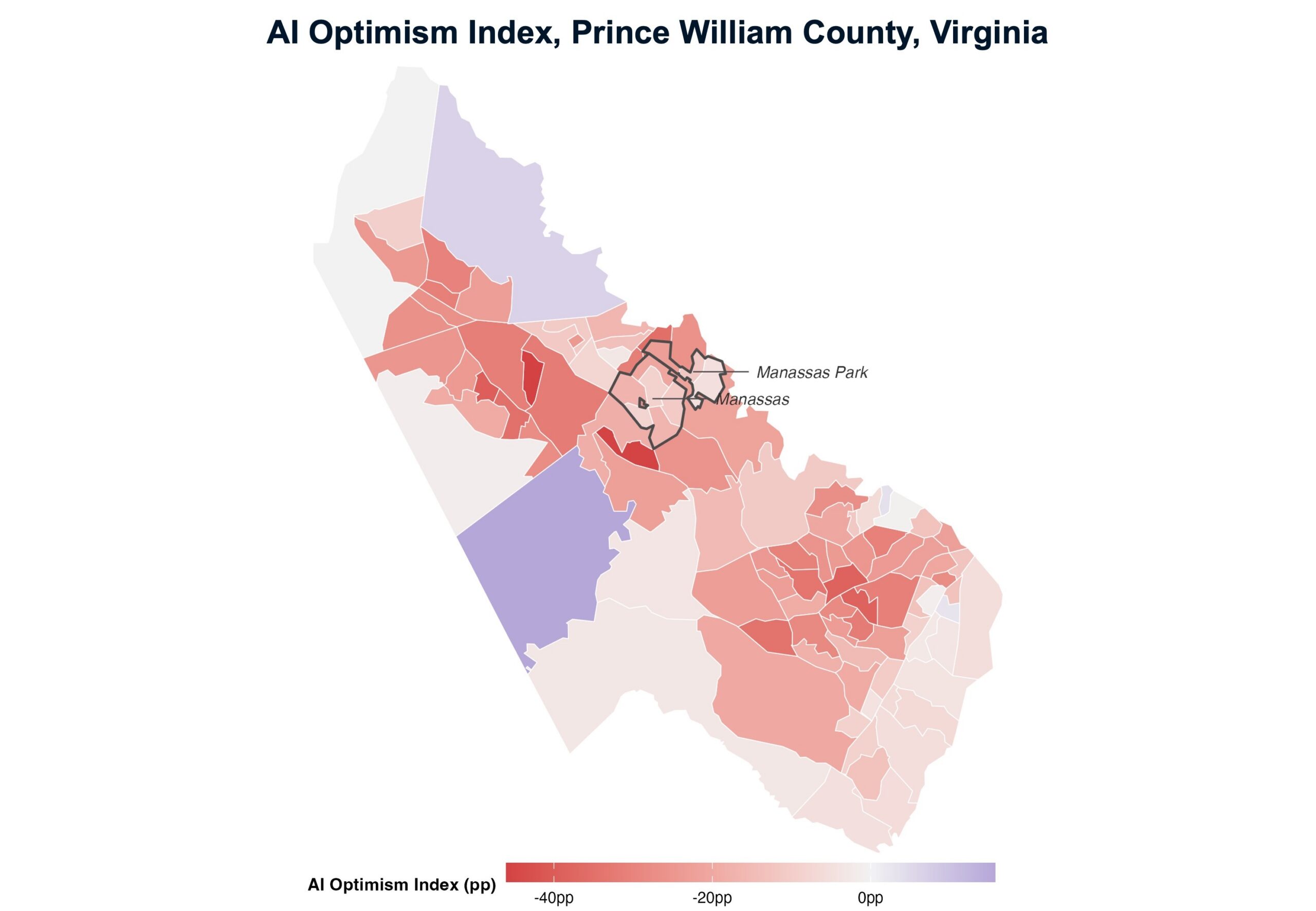
Source: Fraym data (February 2026) and analysis.
The county’s AI Optimism Index is -18 pp — slightly below the national average. But the headline number masks a unique situation: Prince William residents are more informed about AI — both its promise and its risks — than almost any other community in the country.
On the benefits side, residents are far more likely to cite improved productivity, advances in medicine, and automating everyday tasks. This is not a county that has written off AI’s potential for improving people’s lives.
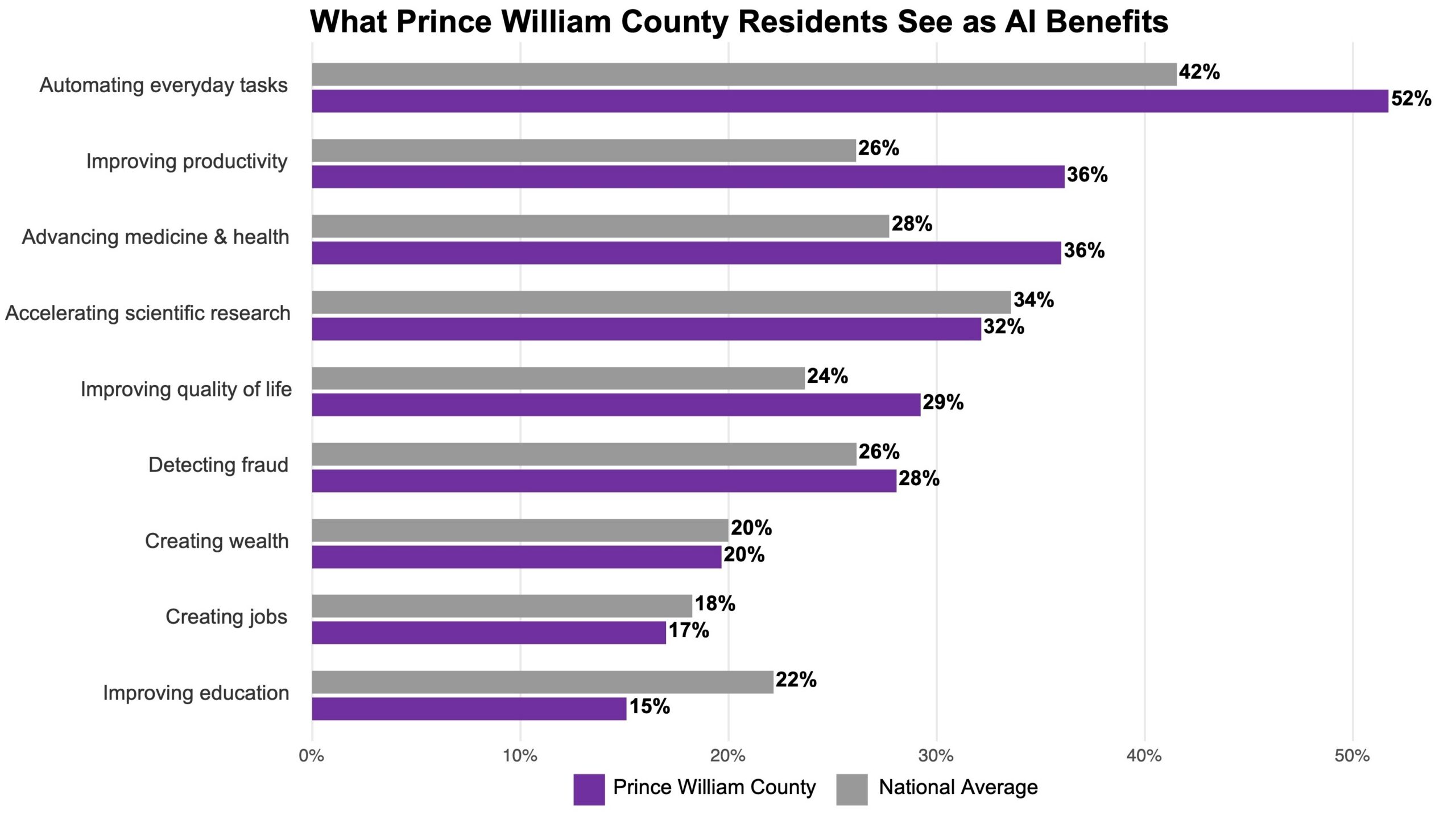
Source: Fraym data (February 2026) and analysis
Yet the risk side of the equation is even higher. A significant number of people raise concerns about privacy and surveillance, job automation, misinformation, and algorithmic biases. All at greater levels than the national average. Interestingly, residents are slightly less concerned about AI increasing electricity costs. So, the most salient concerns are about AI itself — not the infrastructure that powers it.
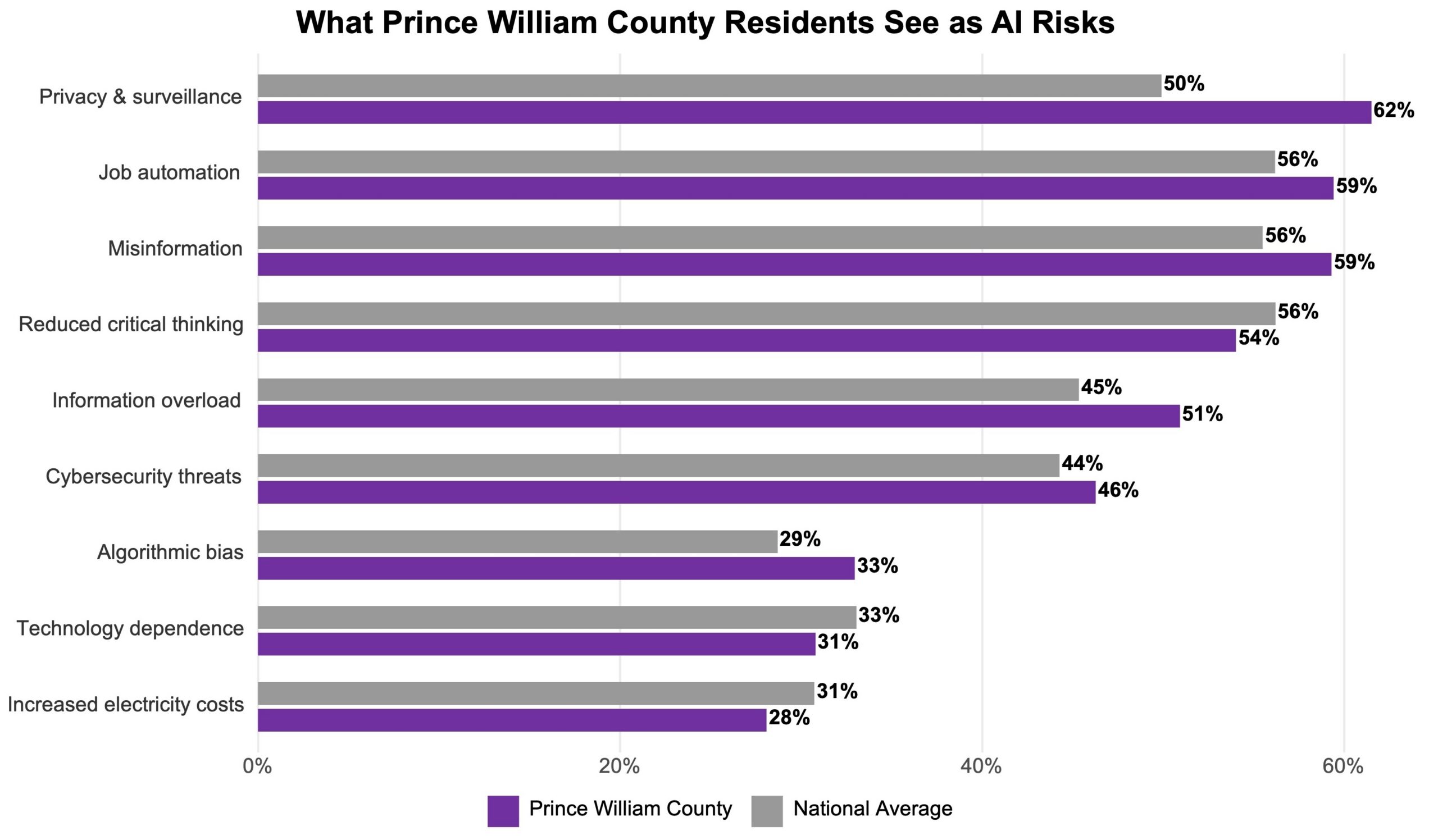
Source: Fraym data (February 2026) and analysis
Now back to the stark stat that should give us pause. Nearly 96% of U.S. counties are net-pessimistic about AI. That means community support must be earned and built. And companies that understand local attitudes – particularly around specific risks – before investing billions of dollars will be operating with the lights on.
Interested in tracking trends like these down to the census tract level across the U.S.? Contact Melissa Persaud at [email protected].