Blog
The $64 Billion Question

Read More
Blog

On May 25th, Pope Leo XIV released Magnifica Humanitas — the first papal encyclical in Church history dedicated entirely to artificial intelligence. The document runs 43,000 words and calls, in some of its most forceful passages, for AI to be “disarmed” — freed from the armed competition of geopolitical and commercial dominance. It is the strongest moral statement on AI ever issued by a global religious institution.
The Pope is not echoing where his American flock is. He is challenging them to move.
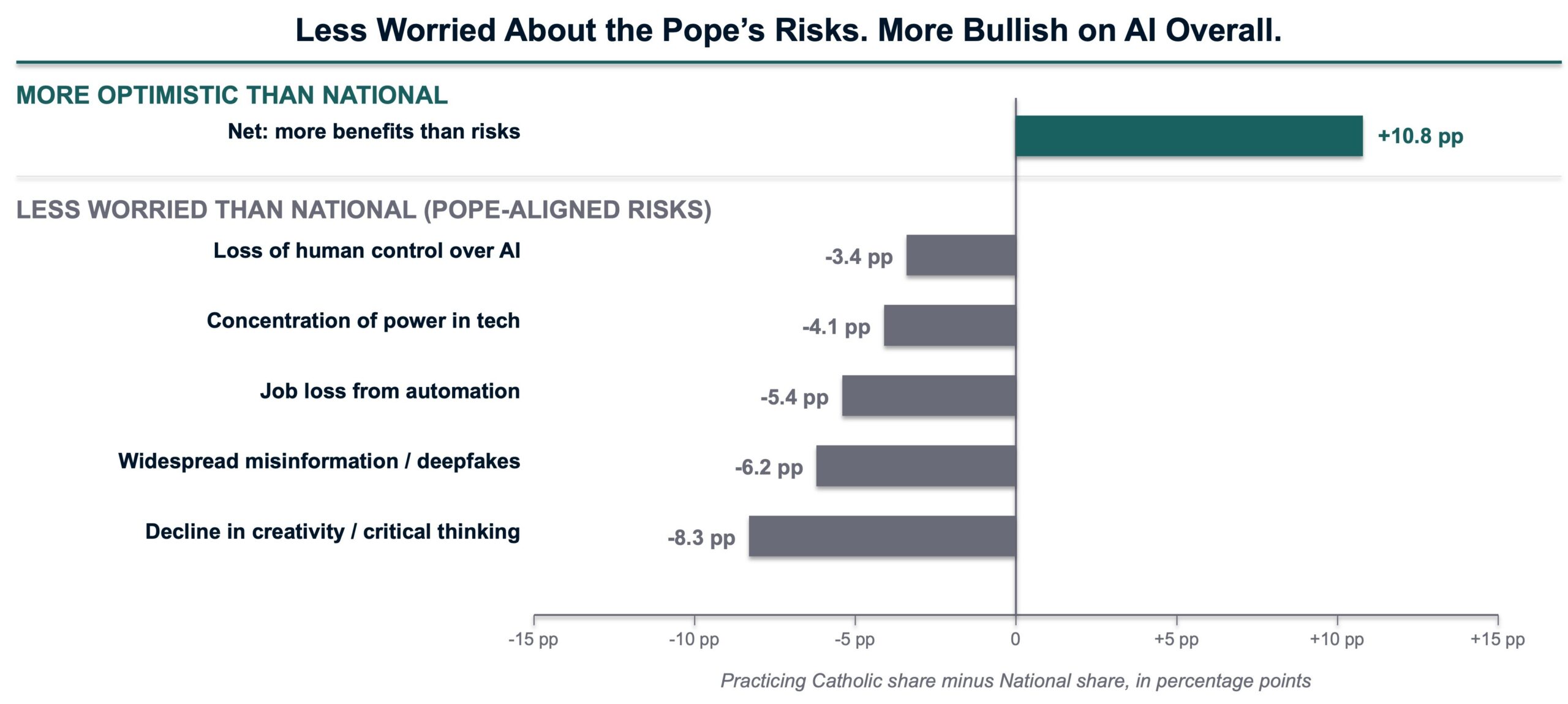
Since November 2025, practicing Catholics — defined as Roman Catholics who attend services at least once a week — have been between 8 and 15 percentage points more likely than the national average to say AI presents more benefits than risks.
This has been an extremely stable signal. Practicing Catholics were not briefly optimistic about AI in one month and skeptical in the next. The gap held in November, in January, in March, and in early/mid May — the most recent reading, completed days before the encyclical’s release. This is not a noisy trend. It is a consistent baseline.
Source: Fraym data and analysis
Every month measured, practicing Catholics have been roughly 10 percentage points more likely than the national average to interact with AI at least several times a week. In May 2026, that gap reached nearly 13 points.
They also see more benefits, almost across the board. In May, practicing Catholics out-indexed the national average on increased job productivity (+13.3 pp), more accurate weather forecasting (+12.3 pp), better fraud detection (+9.9 pp), simplifying daily tasks (+9.9 pp), creation of new types of jobs (+8.6 pp), and improving quality of life for the elderly and disabled (+7.6 pp). On “I see no benefits,” they were 10.4 percentage points less likely to agree. Across the full benefits battery, practicing Catholics see more upside in AI than the country does.
Source: Fraym data and analysis
Here is where the data gets interesting. On three specific AI concerns that map closely to Magnifica Humanitas, the gap between practicing Catholics and the national average has compressed over the last several months:
In each case, practicing Catholics began the period markedly less concerned than the national average and ended it roughly at parity — or, in the case of bias and tech monopoly power, slightly more concerned. The Pope’s framing is not arriving in a vacuum. It is arriving in a population that, on these three issues, was already moving quietly in his direction.
All of this is pre-encyclical. Fraym’s May 2026 wave was completed before Magnifica Humanitas dropped on May 25th. So the data above isn’t the response – it’s the baseline going in.
Overall, the story since last fall has been one of stable, outsized optimism. Practicing Catholics have been consistently more bullish about AI than the national average, more frequent users of it, and less worried about nearly every risk we measure. The exception is the real, small narrowing this spring on the handful of themes Pope Leo just placed at the center of Catholic moral teaching.
The June wave is going to be one of the more interesting data points of the year. If the seven-month average gap (+10.8 pp) holds, the encyclical didn’t move practicing American Catholics. If it narrows, the most consequential moral statement on AI ever issued has landed.
Overall, the story since last fall has been one of stable, outsized optimism. Practicing Catholics have been consistently more bullish about AI than the national average, more frequent users of it, and less worried about nearly every risk we measure. The exception is the real, small narrowing this spring on the handful of themes Pope Leo just placed at the center of Catholic moral teaching.
The June wave is going to be one of the more interesting data points of the year. If the seven-month average gap (+10.8 pp) holds, the encyclical didn’t move practicing American Catholics. If it narrows, the most consequential moral statement on AI ever issued has landed.
Interested in tracking trends like these down to the census tract level across the U.S.? Contact Melissa Persaud at [email protected].