Blog
The $64 Billion Question
Read More
Blog

Ask Americans whether they want a data center in their community, and half say no—outnumbering strong supporters nearly five to one. Driven by fears of rising utility bills (62%), power grid strain (56%), and heavy water usage (54%), the national data suggests the data center fight is essentially decided. America is dominated by NIMBYs.
The state map tells the same exact story. Forty-eight of fifty states are net negative, spanning the political spectrum from Massachusetts to North Dakota (both at –20 points). Left and right seem united: data centers are bad for local communities.
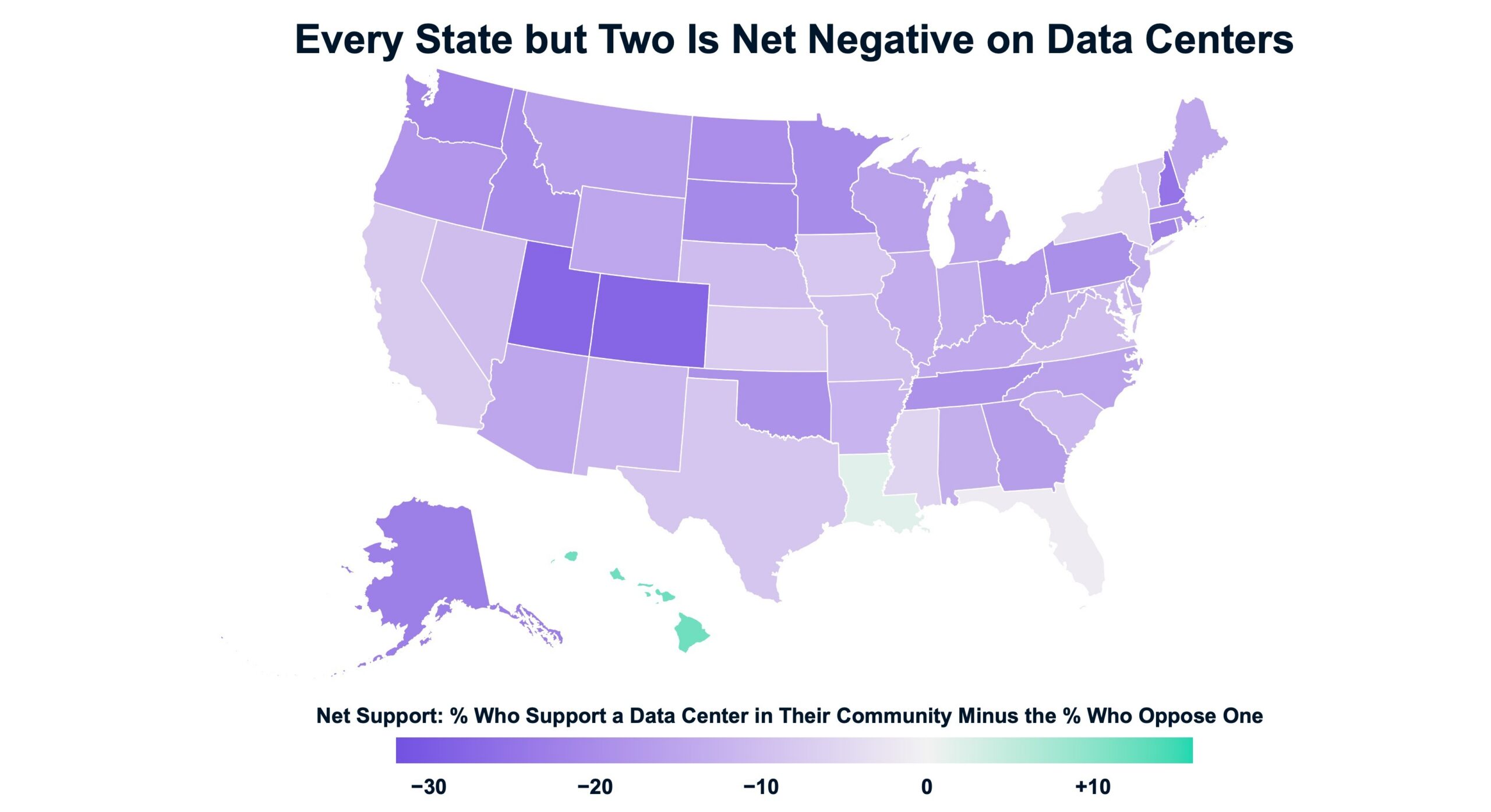
Source: Fraym data (July 2026) and analysis
That is where a typical poll stops. It’s also where the actionable, nuanced information begins. Drop one geographic level, from states to counties, and the seeming consensus shifts dramatically.
Of the 3,144 U.S. counties, about one in six (568) are actually net supportive of a new data center in their own backyard. These YIMBY counties hold 12% of the American population, or roughly one in eight Americans.
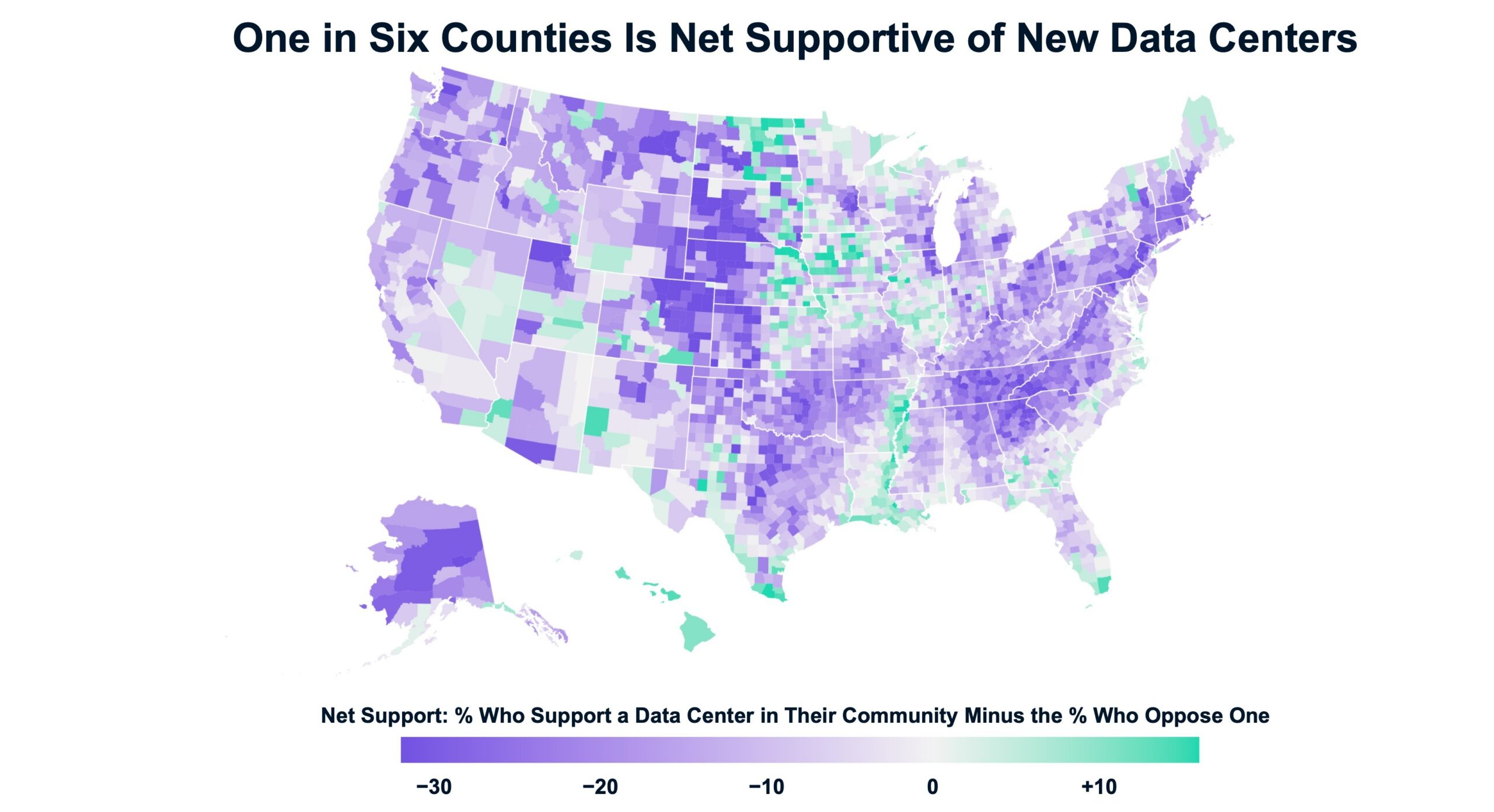
Source: Fraym data (July 2026) and analysis
Fascinatingly, these YIMBY counties are not less worried than others. Their concerns track those of every other county almost exactly, within two to five percentage points on utility bills (59% vs 61%), water (52% vs 55%), noise pollution (33% vs 38%), and farmland loss (42% vs 47%). They carry the same anxieties as the rest of the country, yet reach the opposite conclusion. Why?
What seems to separate these YIMBY counties is a palpable sense of decline. Population loss over the past decade predicts county support more strongly than income, education, or 2024 presidential vote share.
Emptying counties are nearly four times more likely to support a data center than rapidly growing counties: 28% of the fastest-declining quintile is net supportive compared to only 8% of the fastest-growing quintile.
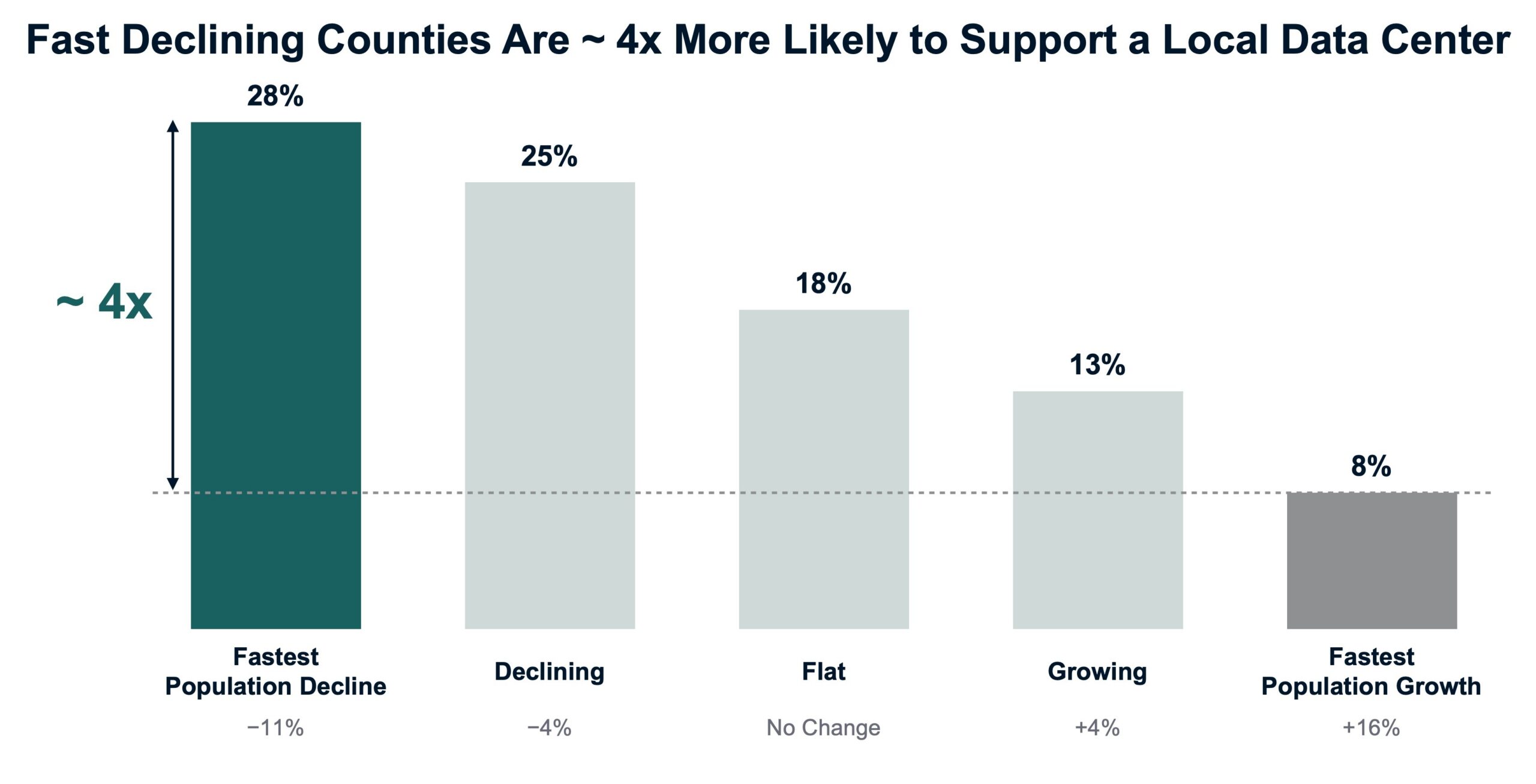
Source: Fraym data (July 2026) and analysis. ACS 2023 5-year population estimates
Eighty-five percent of net-supportive counties fall into two bigger buckets, and they aren’t geographically scattered at random. They run in bands through the Corn Belt and down the Mississippi. The first is agricultural: 320 counties concentrated in Iowa, Illinois, Nebraska, the Dakotas, Minnesota, and Kansas, with a median population under 10,000 and over 80% of their land contained in farms. The second is the Delta and the Deep South: 163 counties mostly in Louisiana, Georgia, Texas, Mississippi, and Arkansas.
On paper, the two groups have almost nothing in common. Farm Belt counties are not poor. Their median household income is $66,800, and their poverty rate is 11%. Both metrics are better than the typical U.S. county. Delta counties are among the poorest places in the country. Their median income is $49,500, and over one-fifth of residents (21%) live below the poverty line. Moreover, Farm Belt counties are 7% nonwhite, and Delta counties are 45% non-white.
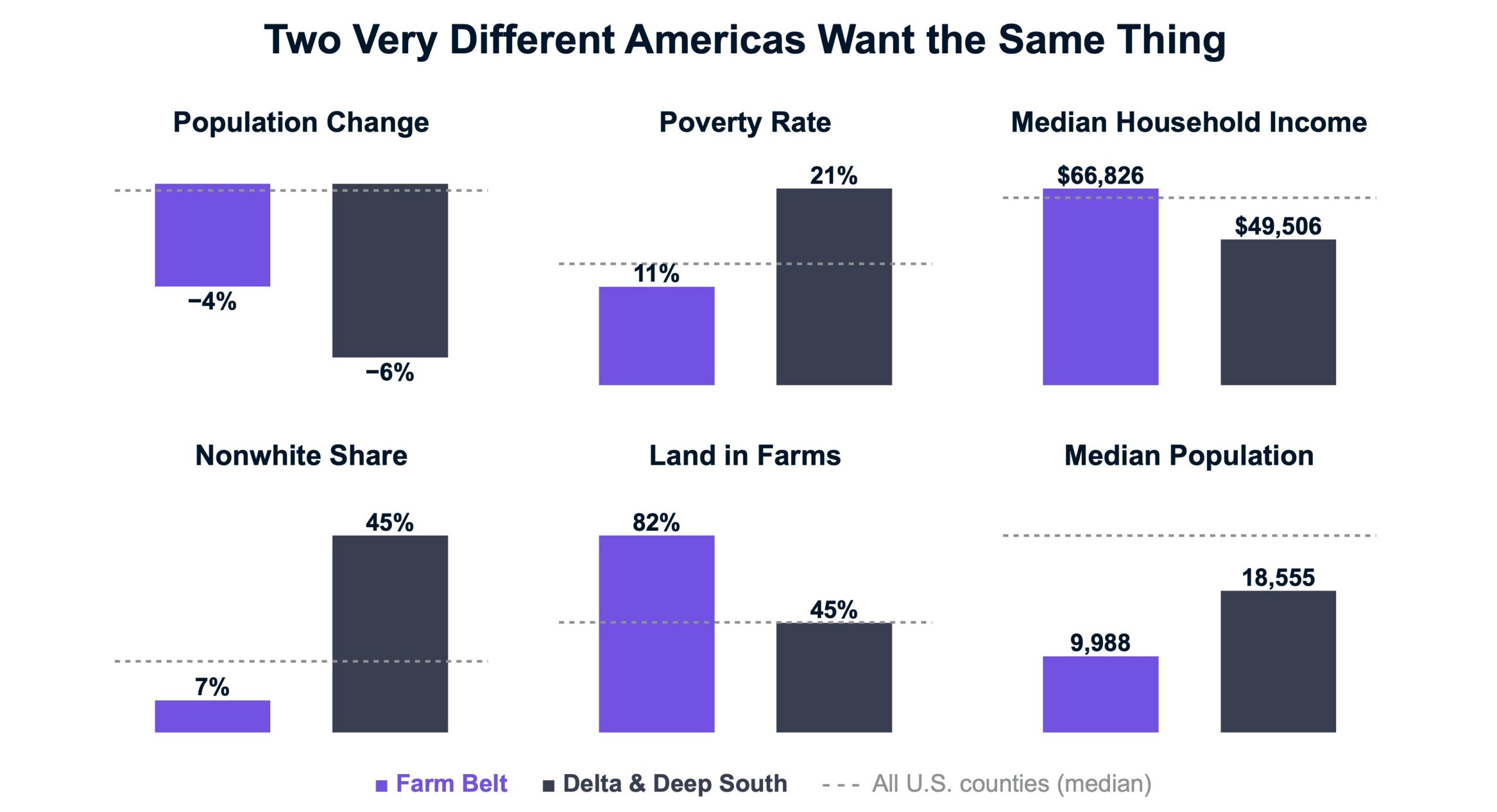
Yet, both groups of counties are emptying out, down 4% and 6% over the last decade. Support for data centers appears to track a community’s growth (or decline) much more closely than its standing.
That reframes the debate. National polls and much of traditional media reporting suggest a country that has made up its mind. Yet, the county-level map describes a country sorting itself by something else entirely — whether communities think they still have a thriving future.
For a county that has lost a tenth of its population in a decade, repurposing 500 acres and bringing in construction crews and new full-time data center jobs are not a threat to a way of life. It might be the first outside capital and meaningful job creation in a generation. And one that more locals than not would welcome with open arms.
Interested in tracking trends like these down to the census tract level across the U.S.? Contact Melissa Persaud at [email protected].