Blog
Mapping America’s Information Blind Spots

Read More
Blog
You don’t have to look far to find a headline that talks about how disconnected, dissatisfied, or divided Americans are today. New Fraym data mapping Americans’ attitudes about service, generosity, and community life at the census-tract level tell a very different story.
The headline is simple and hopeful: the door for connection is open. This year’s Together Tuesday – our national day of local civic action – is meeting a country that is already leaning in.
Let’s start with the number that frames everything. 90% of American adults — roughly 233 million people — say they want to help build a better future.
This desire rests on something deeper than civic obligation. 85% say there is a place for them in America. 84% say being American is an important part of who they are. 88% believe they personally have a role in shaping the country’s future. 90% think people should work together to solve problems, and nearly three-quarters feel they are part of something bigger than themselves.
Whatever our divisions, Americans have not stopped believing they belong here — or that they have something to give.
Source: Fraym data and analysis
This is more than just a feeling. For tens of millions, community engagement is already a normal, regular practice. In the past month alone, 57% of adults reported donating money or supplies to someone in need, 49% turned out for a community event, and 45% volunteered their time. Two-thirds had a meaningful conversation with a neighbor about a shared concern, and half worked alongside someone whose background or views differed from their own to tackle a common problem — the kind of quiet bridge-building no headline ever captures.
Together Tuesday’s on-ramps — individual acts of care, sharing resources, and collective action — describe what many Americans already do. Checking on a neighbor, dropping off donations, and showing up to help. And the trend points up — roughly 58% say they are seeing more people around them pitch in.
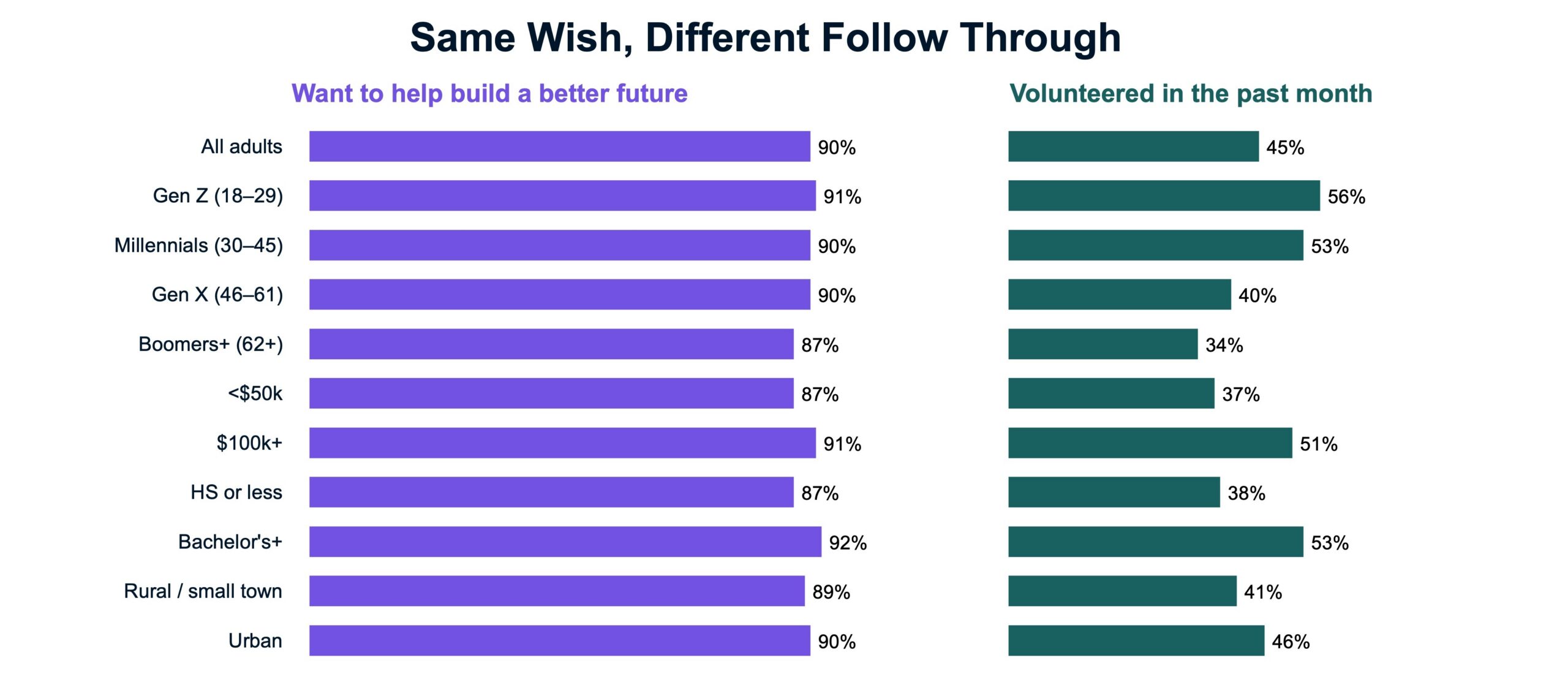
So, where’s the biggest opportunity? Like many behaviors, it lives in the space between wanting and doing — and that gap is arguably the most important finding in our map of America. While 90% want to help, roughly 45% volunteered last month.
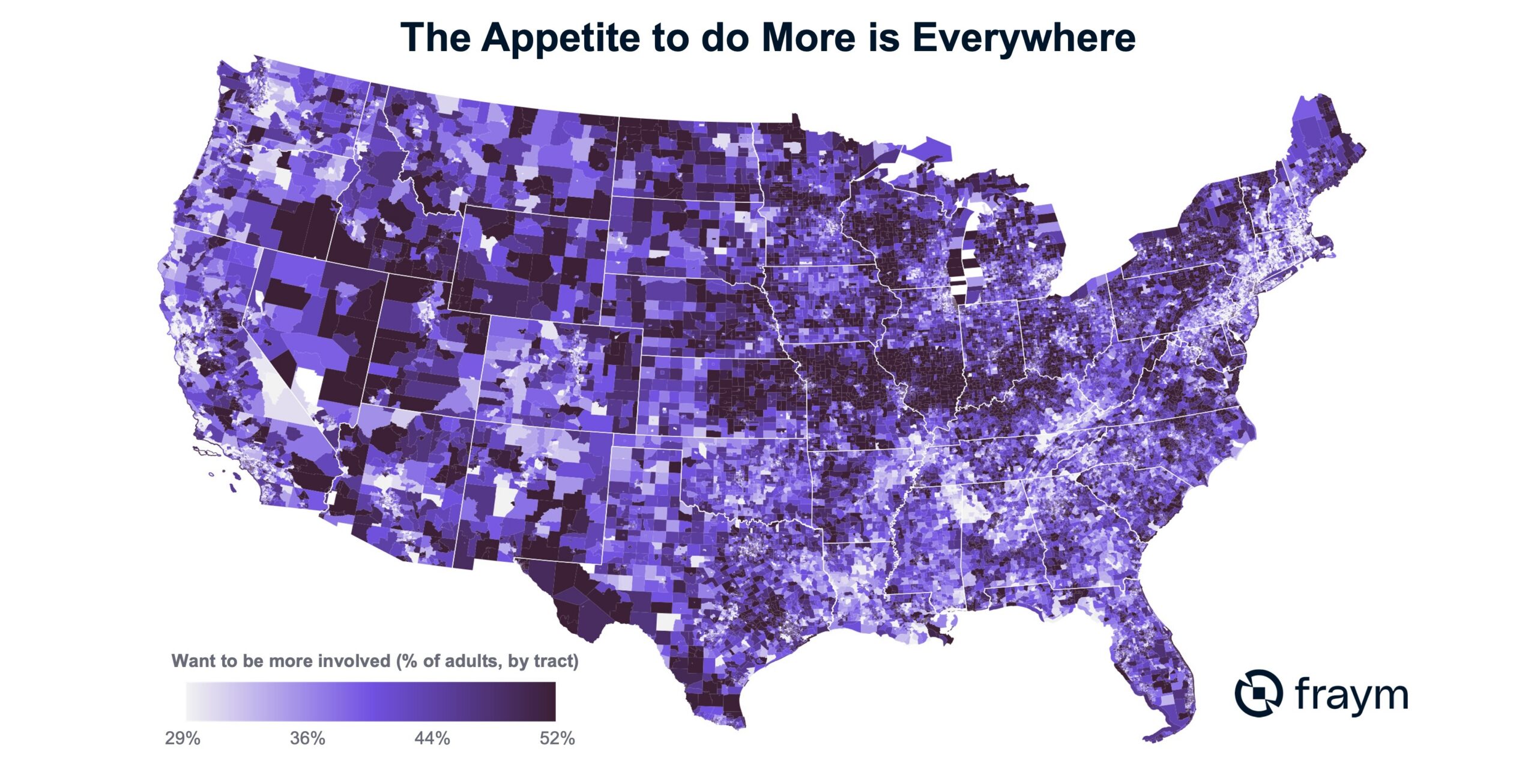
About 100 million adults tell us, plainly, that they want to be more involved than they are today.
Here’s what makes that an opportunity: the desire is nearly universal. Across age, income, education, and where people live, the share that wants to help barely moves — 87% to 92%, a five-point range. What varies is whether they’ve found a way in: volunteering swings from 34% to 56% across those same socio-demographic groups.
The want is everywhere. The on-ramp and follow-through aren’t.
Source: Fraym data and analysis
That pattern doesn’t just hold across people. It holds across places. Map the appetite to do more down to the census tract, and you find it running high in almost every corner of the country.
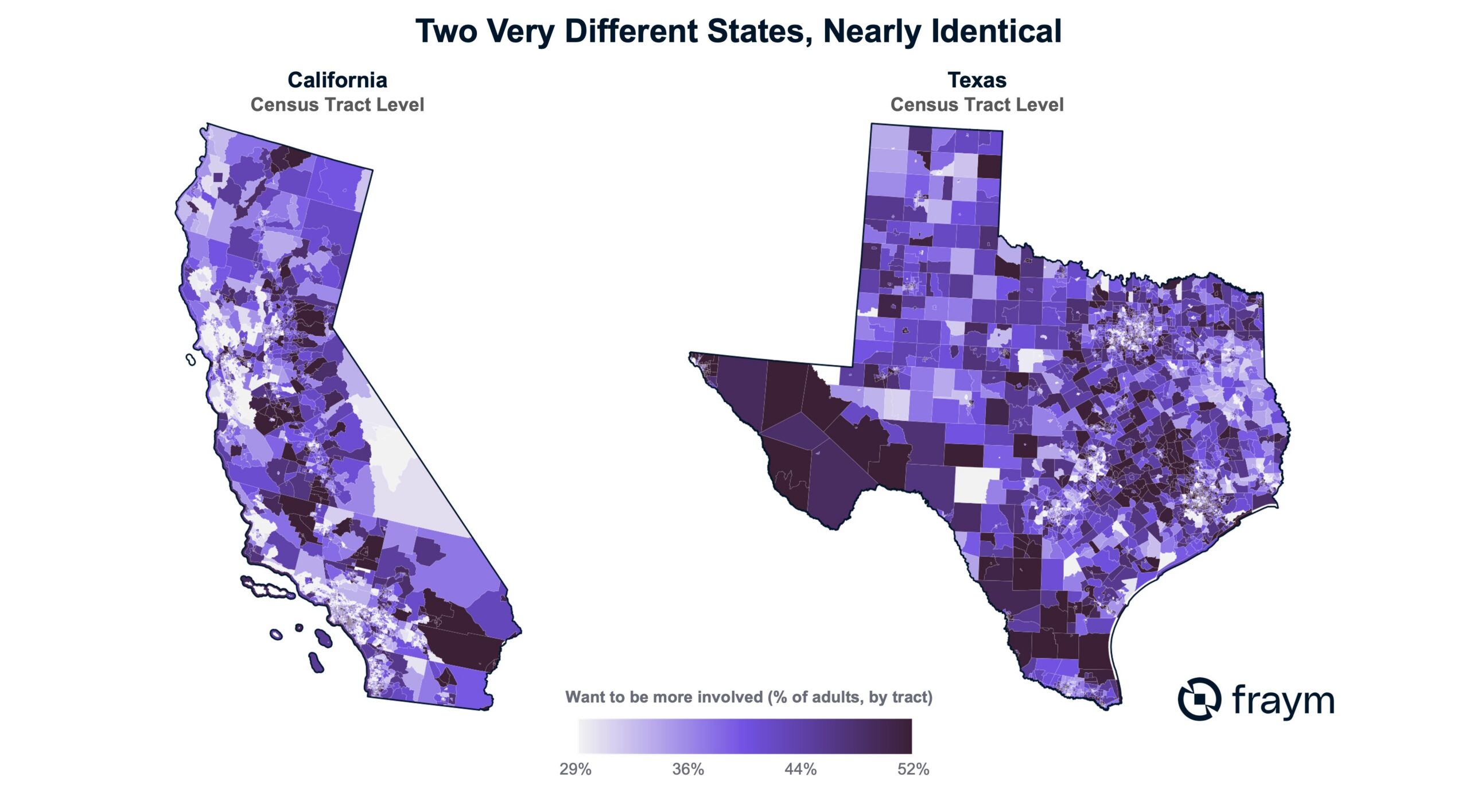
Put California and Texas side by side — two states we’re endlessly told are opposites — and they’re nearly twins: 37% and 41% of adults want to be more involved. The internal pattern matches, too: in both, the appetite spans big cities, suburbs, and small towns alike, and tends to run higher in younger neighborhoods than in the most affluent, settled ones. The instinct to pitch in isn’t red or blue. It’s American.
Source: Fraym data and analysis
If the desire is this universal, why the gap? It’s not apathy; that’s for sure. Only 8% of Americans say they simply aren’t interested. The real barriers are more mundane. People are busy, yes. But millions also say no one has asked them (14%), or that they don’t know how to get involved (15%), or that they don’t know anyone else who is (13%).
Those aren’t brick walls. They’re missing invitations. And an invitation is exactly what Together Tuesday is.
That’s the whole case for Together Tuesday in a single line: it isn’t trying to manufacture goodwill that doesn’t exist. It’s handing a country that already wants to help a simple, permission-free way to act on it. No budget. No grand plan. No title required.
So, this Tuesday, check on a neighbor. Bring someone with you. Show up. One hundred million Americans have already told us they want to do more — are you one of them?
Fraym maps human characteristics at unprecedented resolution to power smarter decisions. To learn more, contact Melissa Persaud at [email protected].