Counties That Rank Highest on Veteran Care Have One Thing in Common
Where Veteran Care is a Top Priority This Memorial Day
On the last Monday of May, the country slows down. In cemeteries from coastal Maine to the villages of rural Alaska, Americans lay flowers, play Taps, and remember the men and women who gave their lives for our freedom. It is also a time to think about the veterans still with us — and to ask how seriously the country takes its obligations to them.
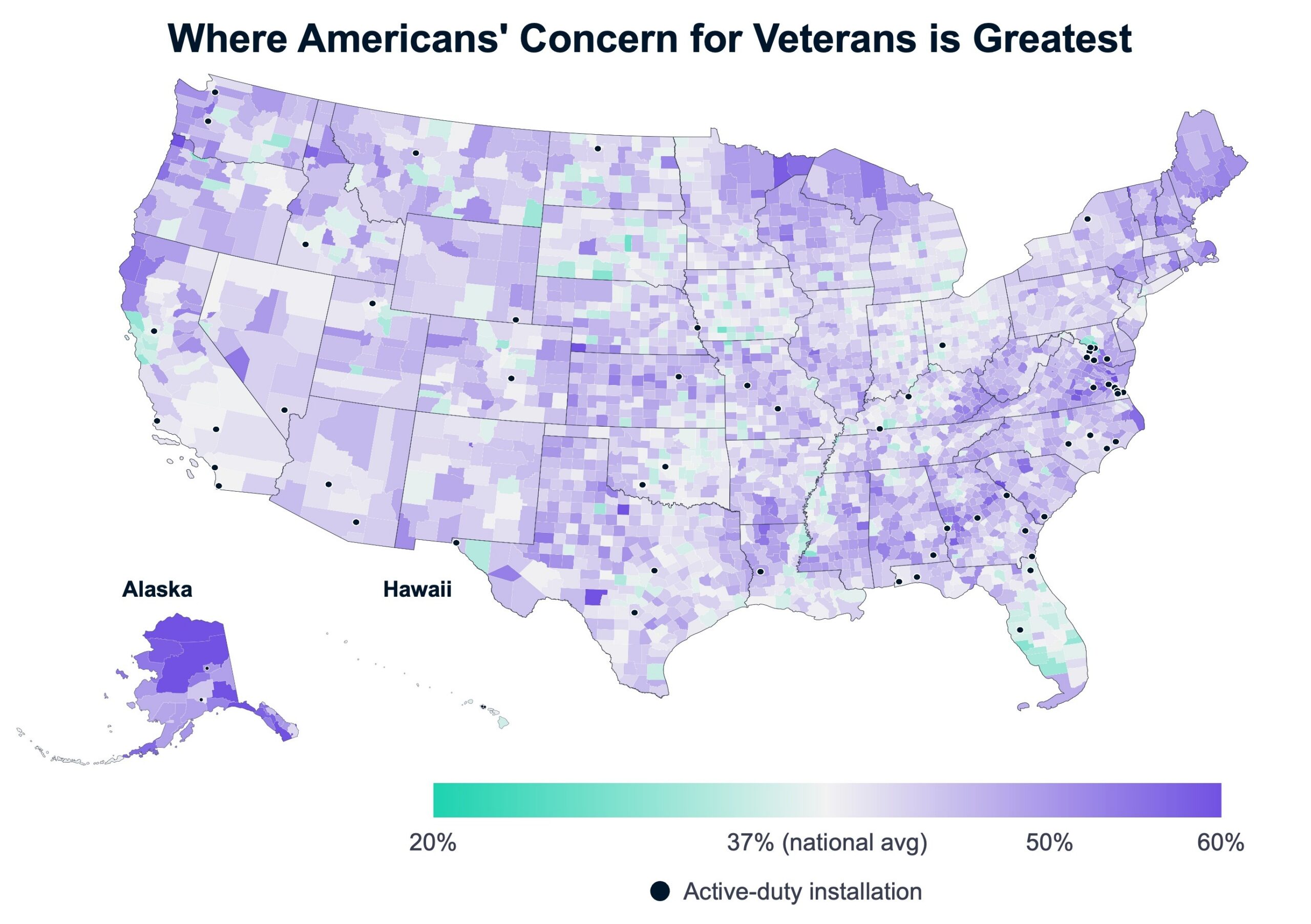
Across the country, more than a third of American adults say “caring for military veterans” should be a top priority for government leaders. This places veterans among the public’s most pressing issues, ahead of education, guns, racial inequality, climate change, and drug addiction.
Concern for veterans concentrates most in rural America. Three of the country’s ten highest-scoring counties sit in Alaska’s bush — Yakutat, Prince of Wales–Hyder, and the Yukon-Koyukuk Census Area — where 63% to 72% of adults call caring for veterans a top priority. The same pattern repeats from the rural Plains to Appalachia, the Deep South, and the small towns of northern New England
The country’s major metros — New York, Los Angeles, San Francisco, Chicago, Boston, Miami — sit near the bottom of the distribution.
The Retirement Factor
What links the highest-concern places is not necessarily a flag-waving culture or proximity to a major military base. It is a high concentration of veterans themselves — Americans who served, came home, and stayed. Concern for veterans tracks where they live, and not necessarily where they served. The pattern shows up most clearly in the states that are themselves most defined by the U.S. military.
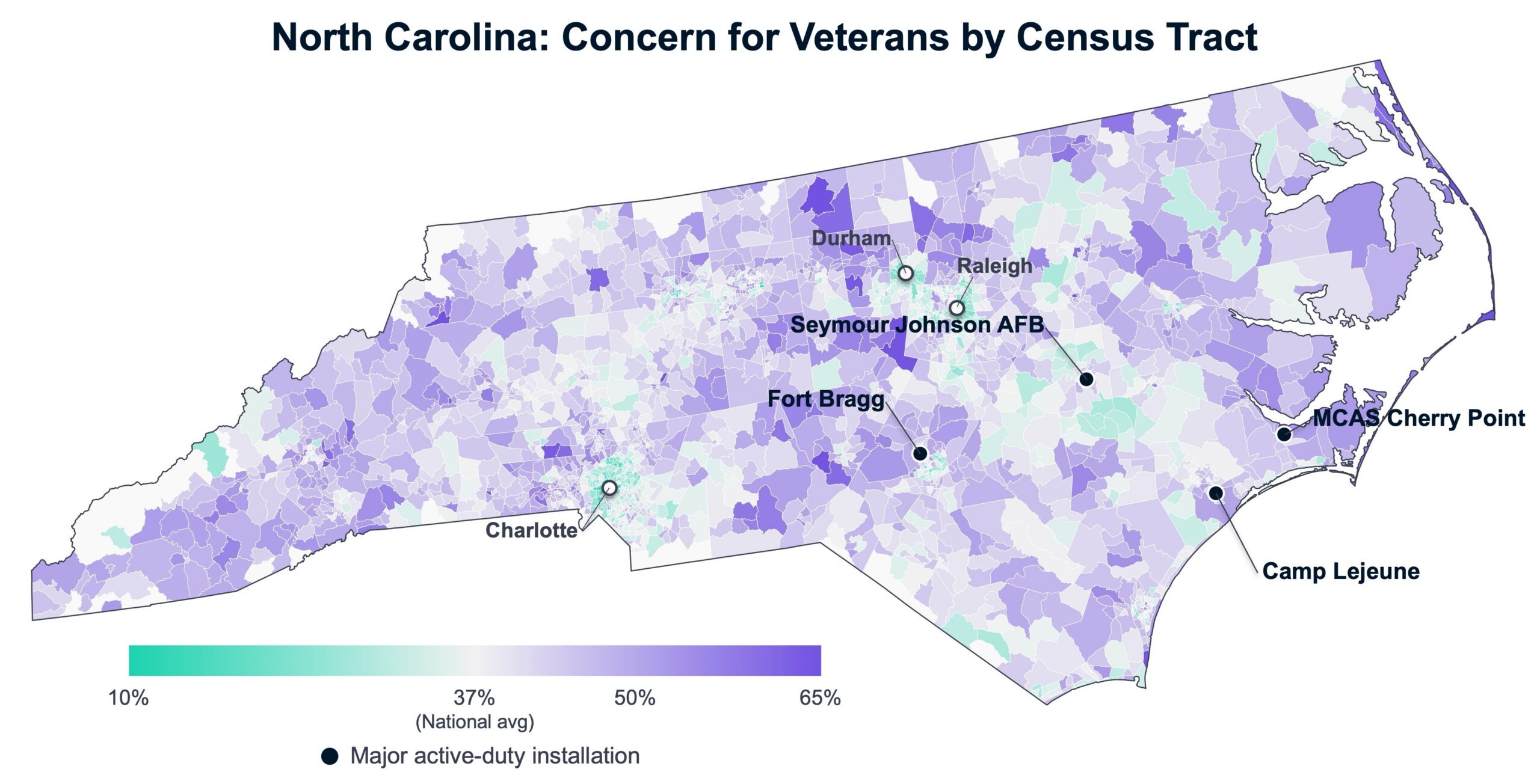
Take North Carolina, home to Fort Bragg (the country’s largest Army base), Camp Lejeune, MCAS Cherry Point, and Seymour Johnson Air Force Base. At first glance, the tract map looks even: concern runs at or just above the national average across most of the state, and the four major installations barely stand out. The state’s three biggest urban centers — Charlotte, Raleigh, and Durham — sit at the bottom of the distribution. The deepest concentration in the state isn’t around the bases at all. It runs along the rural Outer Banks and inner coast — Dare, Hyde, Currituck — where some tracts post scores above 60%. These aren’t base towns. They’re retirement towns: places where veterans have come to live.
Personal Proximity
The pattern reads less like politics than like personal proximity. Where military service is woven into the rhythms of daily life — a neighbor at the VFW, the deacon with a Vietnam pin on his lapel, an old shipmate at the diner counter — the public conversation about veterans is much more personal. And the gratitude is more palpable. Elsewhere, that personal distance can be much greater.
Memorial Day is, in part, the country’s annual reset to close that distance. The maps above show how far some of us still need to travel.
Fraym maps human characteristics at unprecedented resolution to power smarter decisions. To learn more, contact Melissa Persaud at [email protected].
We use cookies to ensure that we give you the best experience on our website. If you continue to use this site we will assume that you are happy with it.