Blog
29 Million Seniors Are Skipping This Season’s Flu Shot
Read More
Blog
Most vaccine outreach relies on retrospective data—claims, health records, and pharmacy rosters showing who has already been vaccinated. That approach misses the far more actionable question: which unvaccinated seniors actually want the vaccine, and where do they live? New Fraym data answers exactly that, revealing a large, specific opportunity hiding inside every state and county average—the willing but unvaccinated.
KEY TAKEAWAY
Just 43 percent of U.S. seniors 75 and older have ever received an RSV vaccine, leaving roughly 5.5 million who want the shot but haven’t gotten one. Overlaying vaccination records with granular intent data—down to the census tract—shows exactly where these willing-but-unvaccinated seniors live, letting outreach campaigns target real demand instead of guessing at the county or state level.
Most vaccine outreach starts from retrospective data: individual claims, health records, and pharmacy rosters of who has already received a shot. Public health teams can track individual-level uptake with high precision. That feels rigorous, but it is backward-looking. Individual tracking tells you who is already vaccinated, not where the remaining potential lies.
The crucial missing element is intent. Which unvaccinated seniors actually want the vaccine, and where do they live? New data answers exactly that, and when overlaid on vaccination records, it identifies a large, specific opportunity: the willing but unvaccinated.
Here’s a brief illustration of how this intent-inclusive approach could significantly boost the efficiency of traditional public and private health campaigns nationwide.
Let’s start with the national picture. The RSV vaccine rolled out to older adults only in 2023, and coverage remains low today. Among adults 75 and older, just 43 percent have ever received an RSV shot. Most of the rest are not refusers; they simply have not been vaccinated yet. By a conservative count, roughly 5.5 million seniors 75 and older want an RSV vaccine and haven’t gotten one. Even the handful of states that report their uptake numbers show the gap plainly: Florida has vaccinated just 25 percent of its 75-and-older residents, California 37 percent. And the gap is not confined to a few states; a large pool of willing but unvaccinated seniors sits in every region of the country.
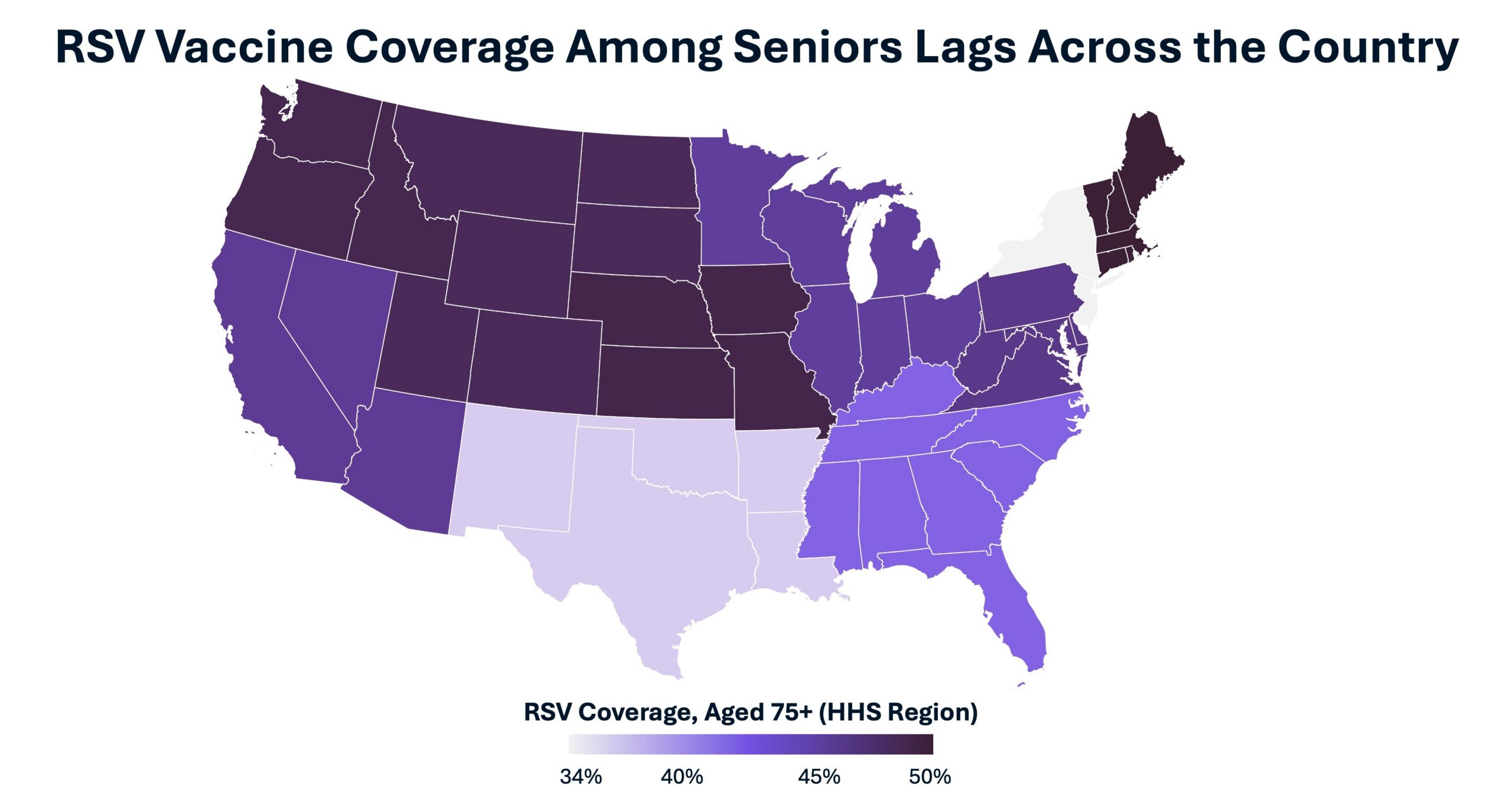
Source: CDC RSVVaxView (NIS-ACM, week ending 2/21/2026). Share of adults 75+ ever vaccinated for RSV by HHS region. National coverage is 43 percent; roughly 5.5 million seniors 75+ remain willing but unvaccinated.
Here’s the challenge traditional healthcare datasets leave unaddressed. Anonymized claims and pharmacy records show where individual shots have already been administered, but they offer little visibility into who remains open to getting vaccinated. Retrospective records show where shots occurred, while community-level intent maps where outreach should go next, revealing the actionable delta between intent and actual coverage.
Let’s look at Washington State to see what happens when you combine the two. It’s one of the only states that publicly publishes RSV vaccination rates down to the county level. Overlay those county records on intent estimates, and a highly actionable number surfaces: about 133,000 Washington seniors 75 and older want the RSV vaccine and haven’t yet gotten it. This is the state’s immediate addressable 75-and-older market.
The largest pools, as expected, sit where the most people are: King County holds roughly 27,500 willing and unvaccinated seniors, followed by Pierce at 14,900, Snohomish at 12,300, Spokane at 10,000, and Clark at 9,900.
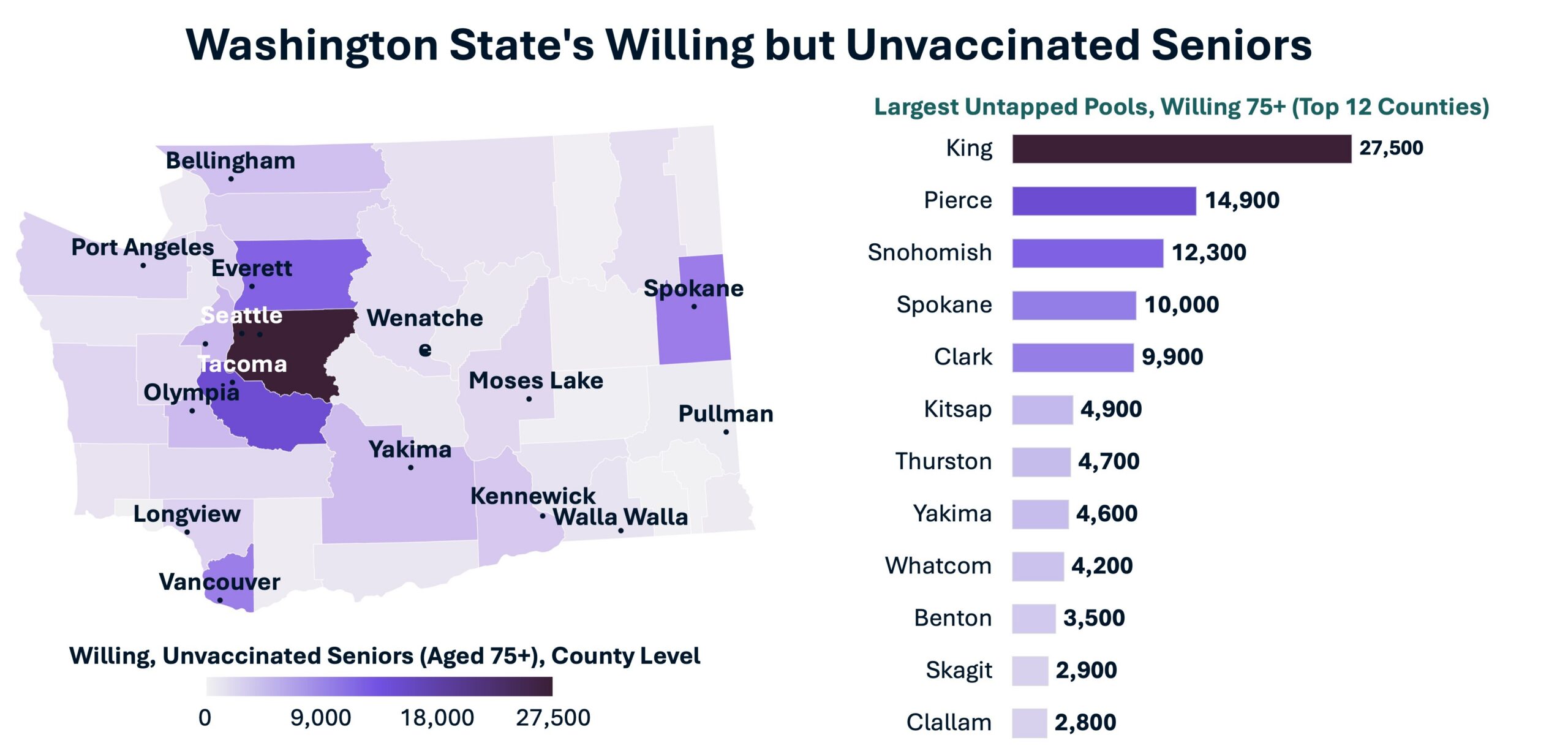
Source: Fraym (July 2026), CDC RSVVaxView, and Washington State DOH (county coverage as of June 2026). Latent demand = unvaccinated seniors 75+ (state records) x estimated RSV willingness (Fraym, 60+ applied to 75+, a conservative approximation).
Campaign budgets are often set at broad administrative levels, while outreach often targets individual patient lists. But neither approach reveals neighborhood dynamics. Zooming into Pierce County, home to Tacoma, reveals that intent is anything but uniform across its 193 census tracts. Willing seniors cluster in specific neighborhoods, and a county-wide ad buy would waste most of its money reaching people who will never convert. The tract view puts trusted activation messengers exactly where the most receptive seniors are clustered.
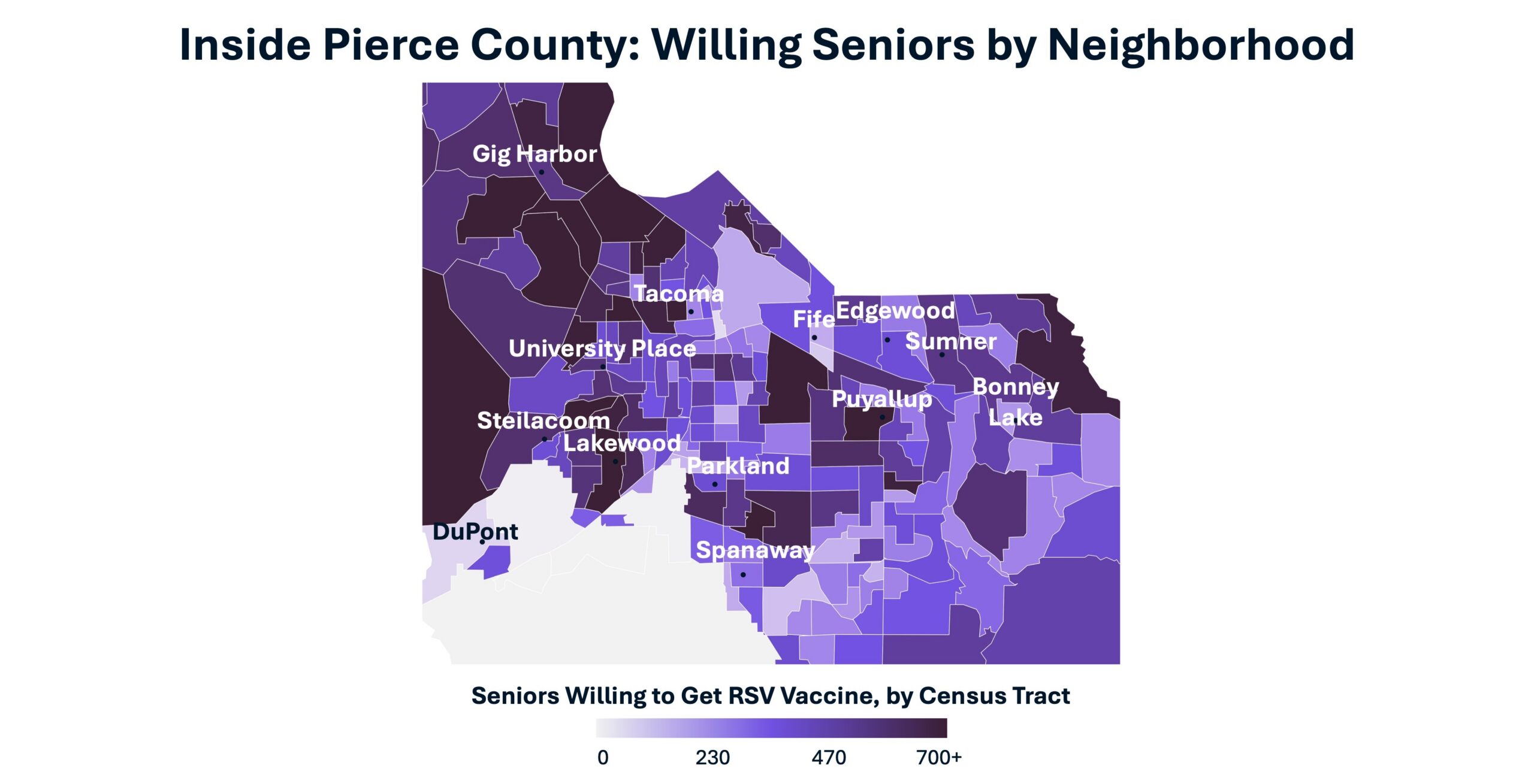
Source: Fraym (July 2026). Willing seniors (60+) = tract 60+ population (ACS 2023) x modeled RSV willingness. Tract-level vaccination rates are not published, so this illustration shows intent only.
Neighborhood-level audience data also shows which media properties seniors use the most, so a campaign can match message, messenger, and mode to the audience instead of guessing. More than three-quarters of Pierce County’s seniors are on Facebook and half are on YouTube, but they’re also highly reachable through traditional media: network news broadcasts reach a third or more of them, and local news and local radio still pull real audiences. The winning plan meets them across the whole mix, digital and analog, not one channel or the other.
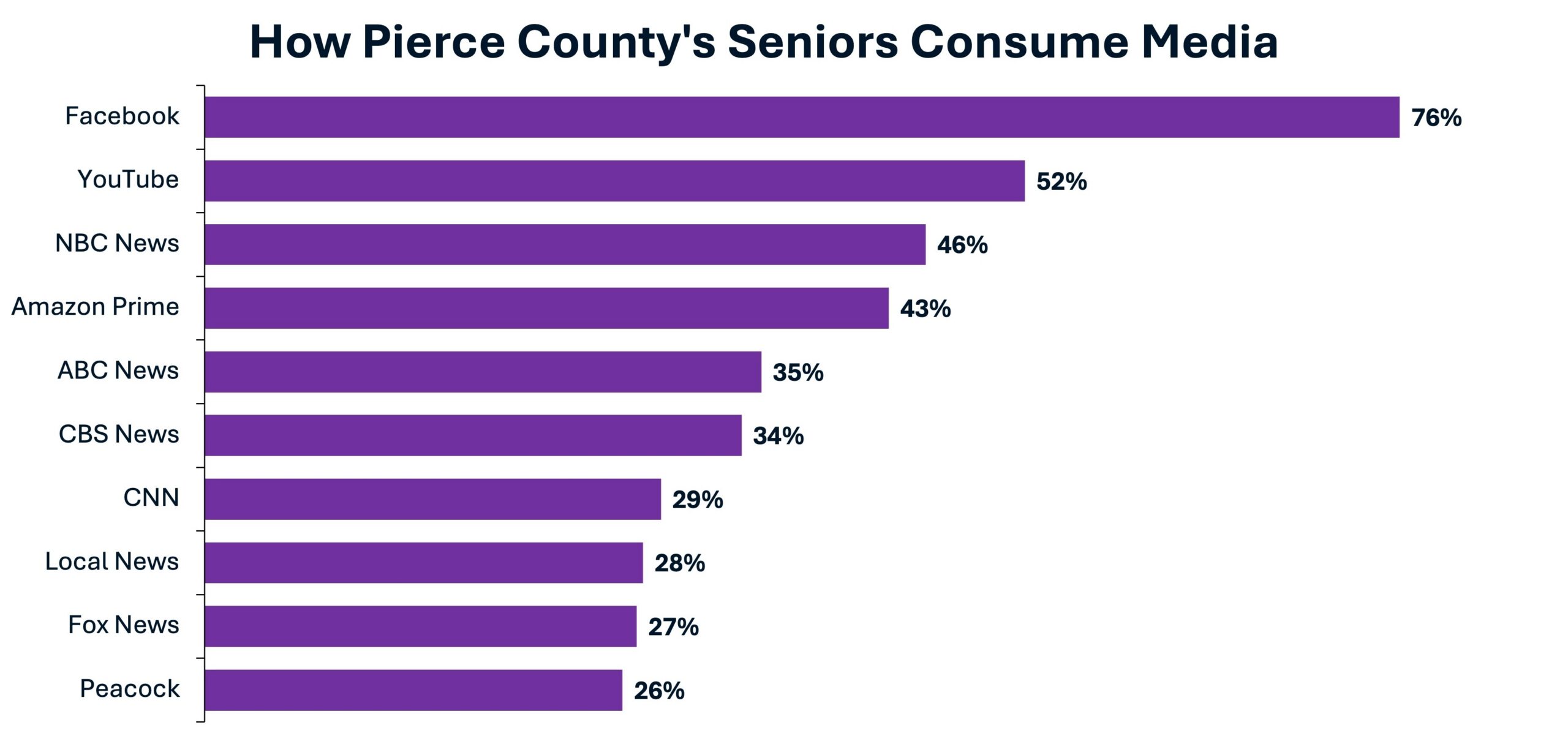
Source: Fraym data (June 2026) for adults aged 60+ and analysis. Figures display self-reported use in the past week.
Why does this approach matter so much for a disease like RSV? Because RSV is a one-and-done vaccine. A single dose delivers durable protection, so every willing senior you convert is a permanent addition to cumulative coverage, not a patient you have to win back next season. That changes the strategy completely. “Protecting last year’s footprint” is a seasonal-vaccine approach. For a one-and-done shot, the only efficient way to raise coverage is to find the willing but unvaccinated and go get them as efficiently as possible.
None of this requires abandoning the data health systems already use. It simply requires adding the critical element that’s been missing. By combining administrative uptake records with precise intent data mapped to the neighborhood level, we stop hiding willing-but-unreached seniors inside a statewide average. This might just be the biggest, lowest-hanging fruit for expanding immunization coverage.
The RSV vaccine is safe and available, millions of seniors already want it, and we now know where they live. The only question left is whether we’ll start leveraging healthcare intent and preference data to move the needle nationwide.
Leo, B. (2026). 5.5 Million Seniors Are Skipping the RSV Vaccine They Want. Arlington, VA: Fraym.
For questions or additional information, please contact:
Ben Leo
Executive Vice Chairman & Co-Founder
Email: [email protected]
Figures, charts, and maps in this post are drawn from Fraym data (July 2026), CDC RSVVaxView, and Washington State Department of Health county-level records (as of June 2026), except where a different source is cited inline. Latent demand estimates the unvaccinated population aged 75 and older, based on state health records, that is willing to be vaccinated, using Fraym’s modeled RSV willingness data. Willingness is estimated for adults 60 and older and applied to the 75-and-older population, a conservative approximation.
Just 43 percent of adults 75 and older have ever received an RSV shot, according to CDC RSVVaxView data. That leaves roughly 5.5 million willing-but-unvaccinated seniors nationwide.
About 133,000 Washington residents 75 and older are willing but unvaccinated. The largest pools sit in King County (27,500), Pierce County (14,900), and Snohomish County (12,300).
Uptake records only show where shots have already happened. Intent data reveals where the remaining willing-but-unvaccinated population lives, so outreach can target real demand at the neighborhood level instead of guessing based on a county or state average.
A single RSV dose delivers durable protection. Unlike a seasonal vaccine, every willing senior who gets vaccinated is a permanent addition to cumulative coverage—which makes finding and reaching the willing-but-unvaccinated population, as efficiently as possible, the single highest-leverage strategy available.