Blog
Where Veteran Care is a Top Priority
Read More
Blog
KEY TAKEAWAY
Three in four veterans name at least one care-related issue (caring for military veterans, healthcare costs, and/or mental health) as a pressing priority for government leaders, but concern is not evenly spread. It runs highest in the Southwest and the Midwest, and standard Census Bureau veteran statistics don’t explain why. Only localized data leveraging AI/ML techniques shows where it is felt most.
Every Veterans Day, the country says thank you to those who wore a uniform and defended our nation’s freedom. Yet few people ask veterans what worries them now or what they want their leaders to focus on. So, that’s exactly what we did.
Three in four veterans name at least one care-related issue (caring for military veterans, healthcare costs, and/or mental health) as a pressing priority for government leaders. But these concerns aren’t spread evenly across the country, and we can now show where they’re felt most acutely.
But let’s start with the national picture first. Inflation (58%) and government spending (56%) top veterans’ priorities overall. Care-related issues come next, with caring for military veterans at 54% and healthcare costs at 52%. The future of Social Security and Medicare is right alongside them (52%). Mental health ranks a bit lower at 35%, but that national average hides a lot. We’ll come back to that later.
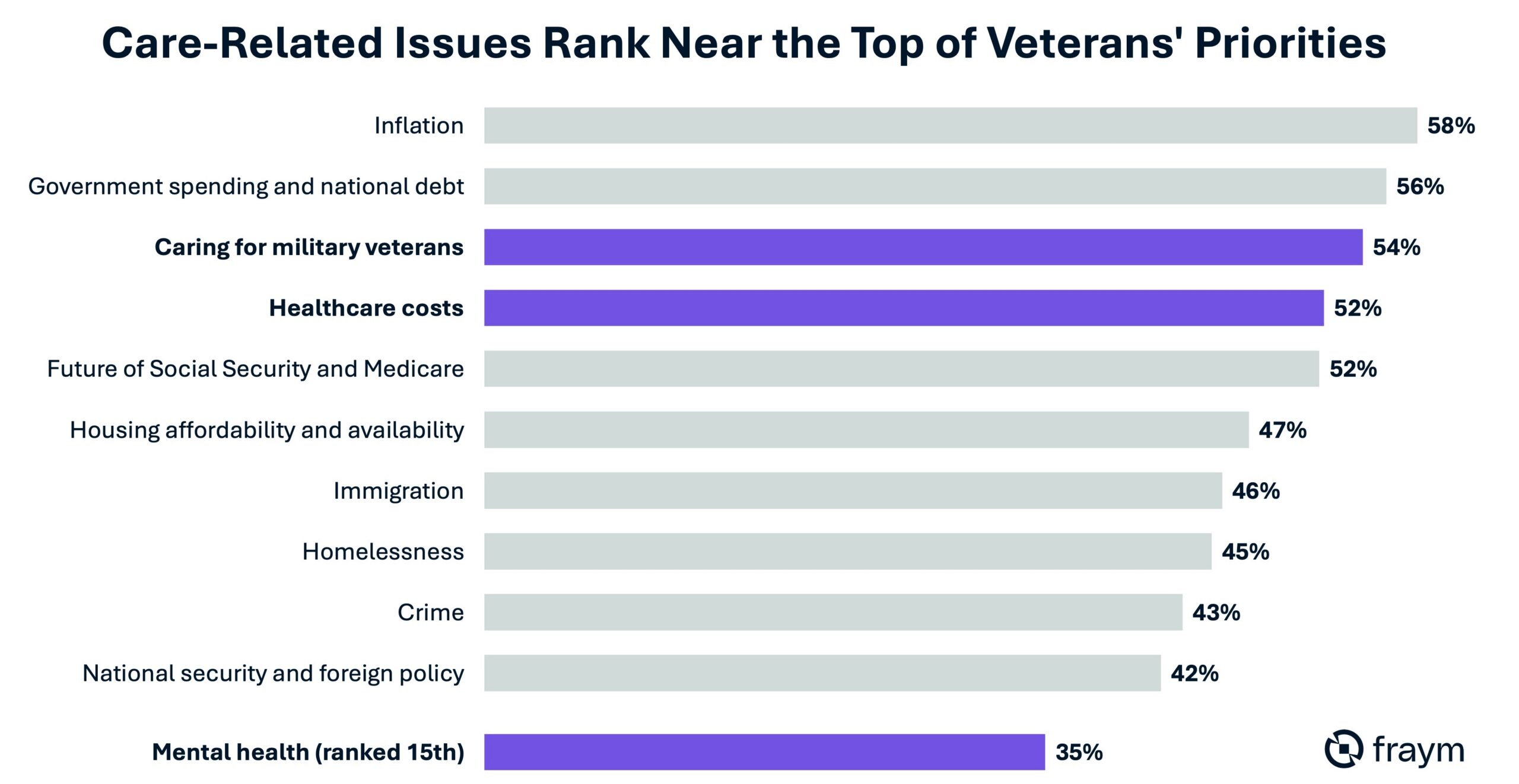
Source: Fraym data (July to October 2026) and analysis. The figures show the share of U.S. veterans selecting each issue as a pressing priority for government leaders.
Next, we created a simple Care Concern measure that averages the shares for caring for veterans, healthcare costs, and mental health. This helps us see where these issues rank highest. Nationally, the Care Concern average stands at 47%, with veterans typically living in counties ranging from 36% to 57%.
Two parts of the country stand out immediately: the Southwest and the Midwest. Arizona (58%), New Mexico (57%), and Nevada (55%) are all well above the national level, as are Kansas (56%), Ohio (54%), and Missouri (54%). Among counties with at least 20,000 veterans, Bernalillo County, NM (62%), Jackson County, MO (61%), and Pinal County, AZ (60%) have the highest levels.
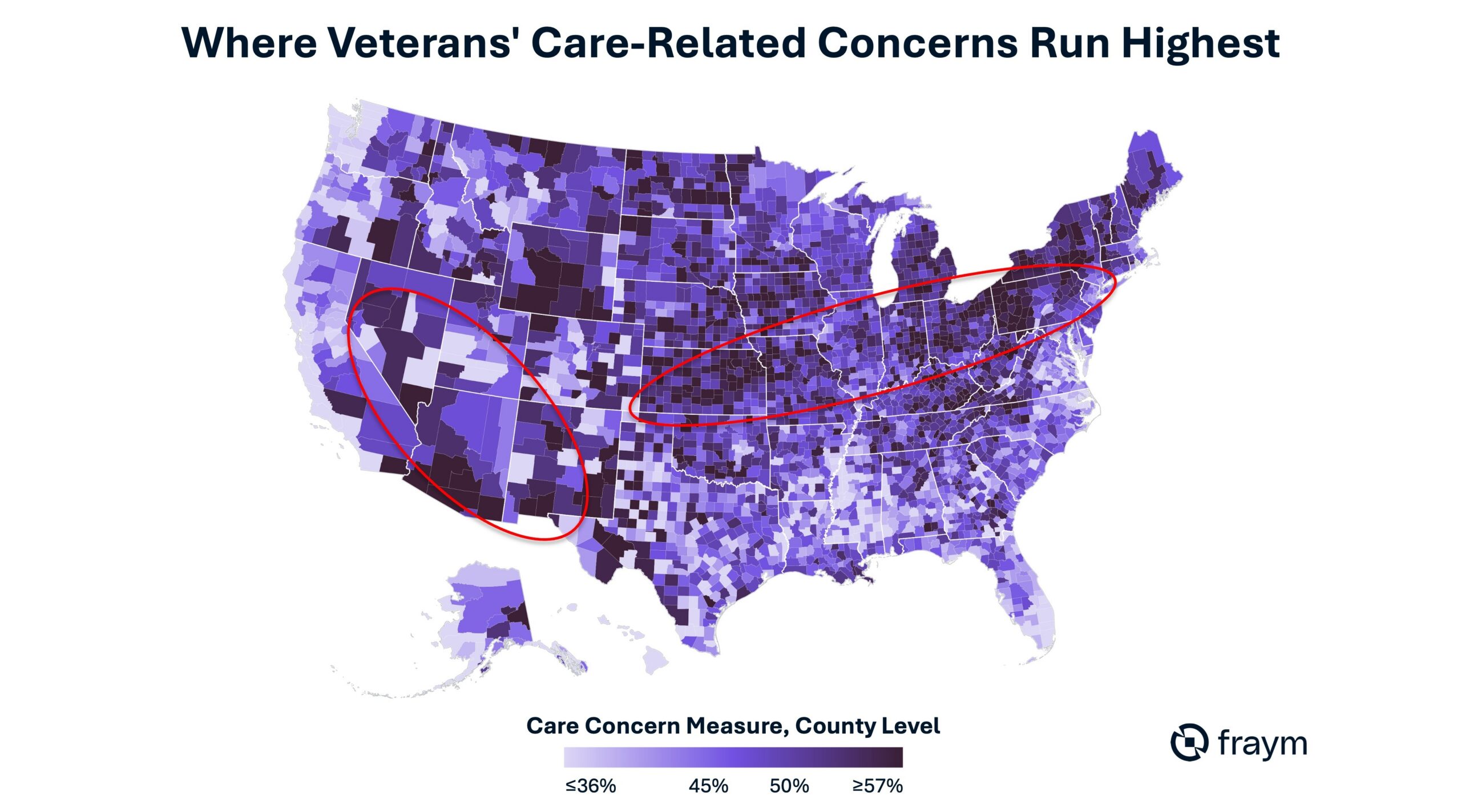
Source: Fraym data (July to October 2026) and analysis. Care Concern is the average share of veterans who cite care for veterans, healthcare costs, and mental health as priorities.
So, what do these places have in common? You might expect older veterans, more veterans with disabilities, or simply more veterans overall. Fascinatingly, that doesn’t seem to be the case. The fifth of counties with the highest Care Concern look nearly identical to the fifth with the lowest: 29% vs 30% of veterans have a service-connected disability rating, 49% vs 50% are 65 or older, and 8% vs 7% live in poverty. Veterans also make up a similar share of adults (8% vs 7%).
In other words, standard Census Bureau indicators about veterans don’t tell us anything that explains geographic differences in their concerns and priorities.
Regional differences in healthcare cost concerns especially warrant a deeper look. Just over half of veterans cite them nationally, but most live in counties where that share ranges from 41% to 61%. Concerns are especially high in Kansas and Missouri (both 62%), which also rank near the top on the simplified Care Concern measure.
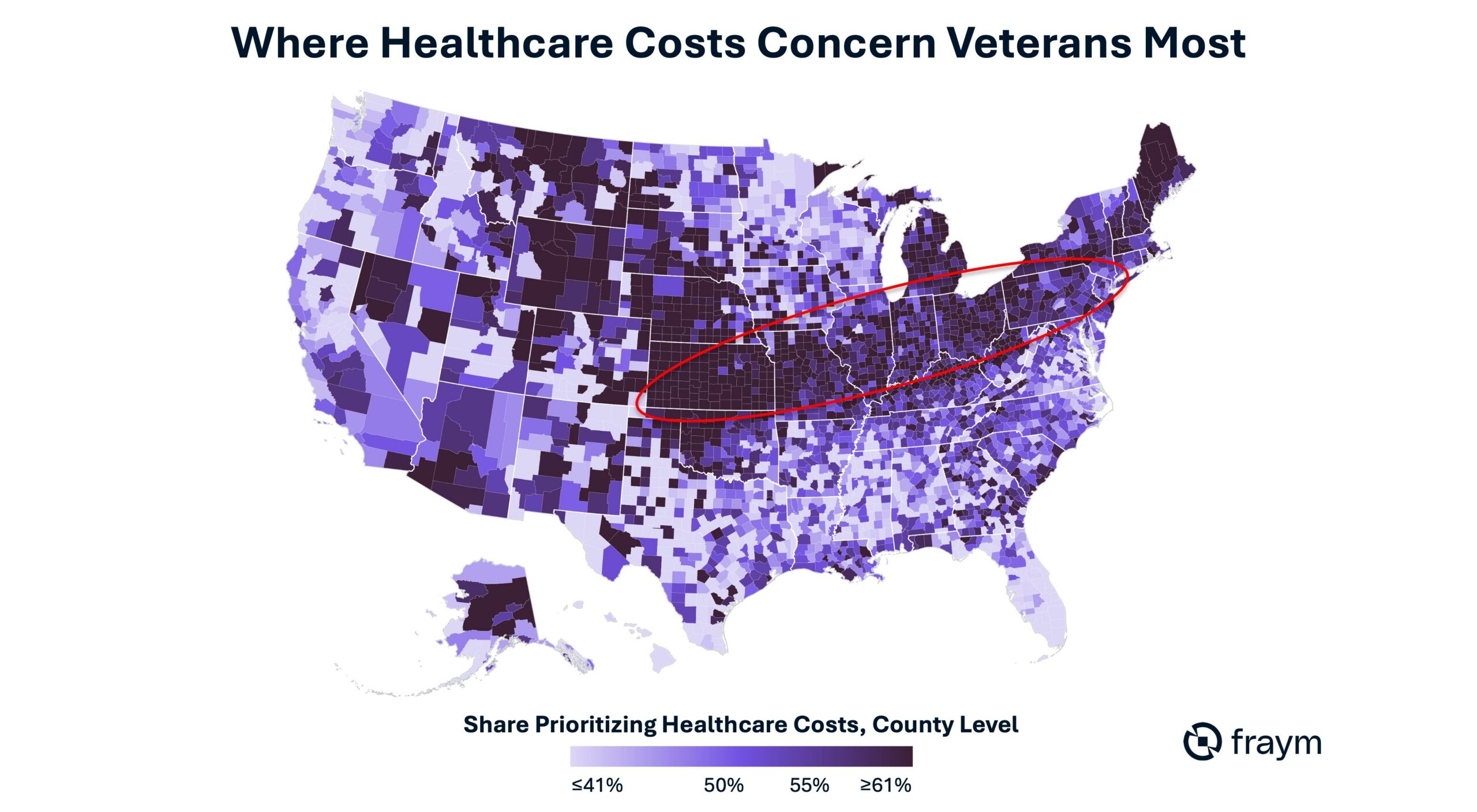
Source: Fraym data (July to October 2026) and analysis. The figures show the share of veterans who selected healthcare costs as a pressing priority for government leaders.
Then there’s mental health. Nationally, it looks like a second-tier issue for military veterans. In the Southwest, it’s anything but. Nevada (54%), Arizona (49%), and New Mexico (49%) are the three highest states, all well above the 35% national level.
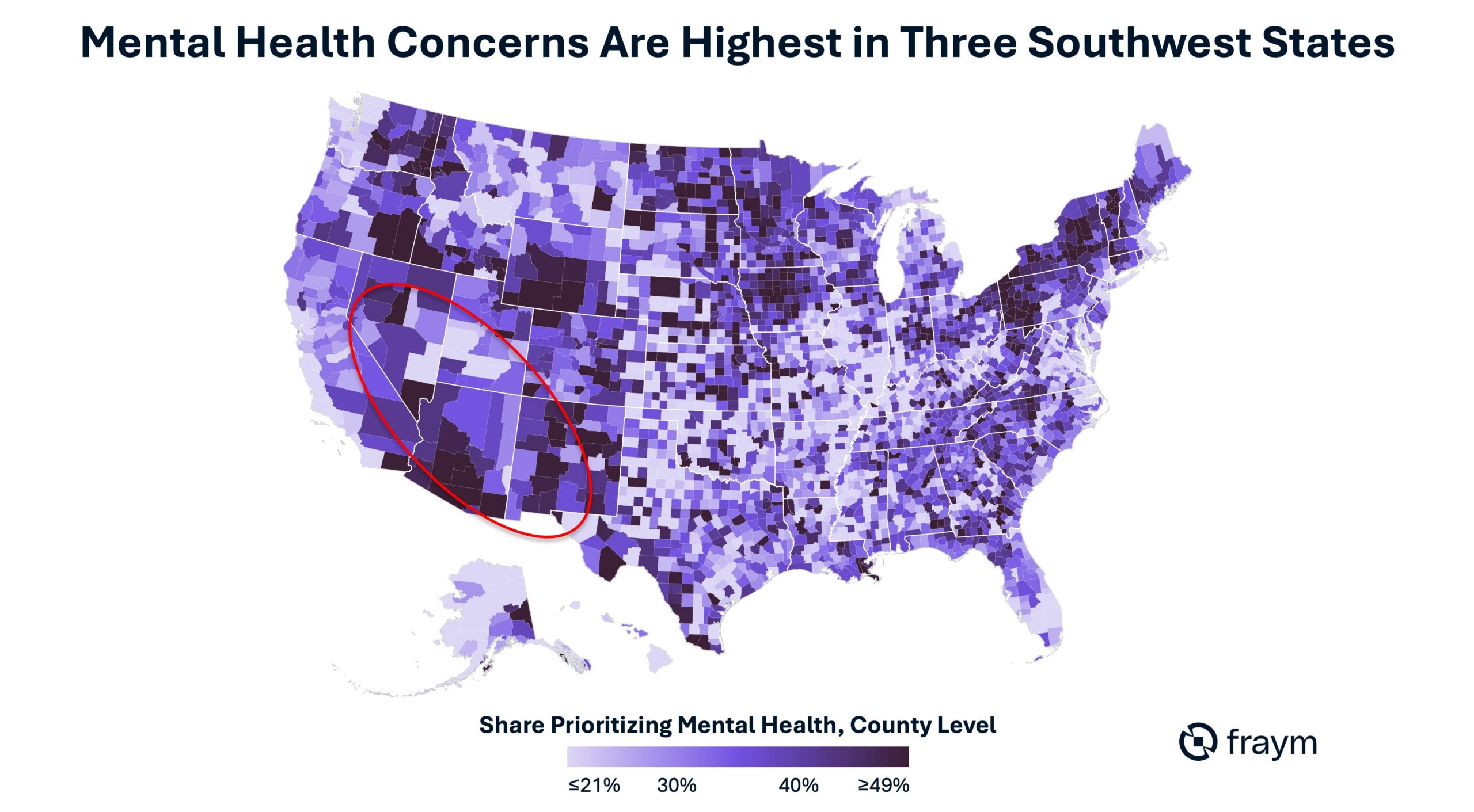
Source: Fraym data (July to October 2026) and analysis. The figures show the share of veterans who selected mental health as a pressing priority for government leaders.
Albuquerque shows why highly localized data is so critical and actionable. Bernalillo County has the highest Care Concern of any large county (62%), with mental health at 61%. Yet, even here, concerns aren’t uniform. Most military veterans live in census tracts ranging from 55% to 69%, which means the county average masks real differences from one neighborhood to the next.
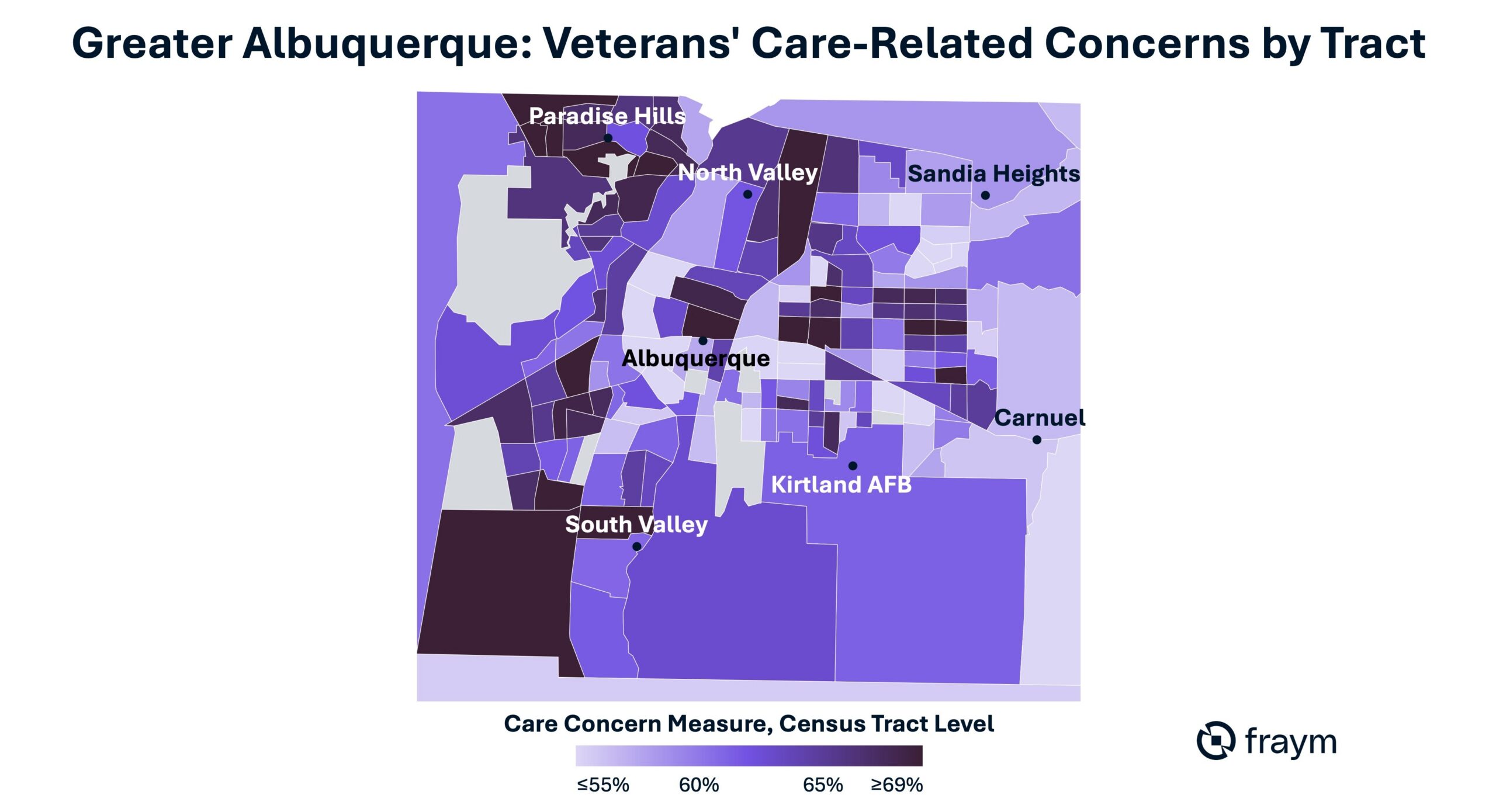
Source: Fraym data (July to October 2026) and analysis. Census tracts with fewer than 50 veterans are not shown.
None of this means veterans are pessimistic across the board. Their Consumer Confidence Index reading stands at 113, where anything above 100 means more positive than negative views on business conditions, jobs, and family income. That includes 43% of veterans who expect their family income to rise over the next six months, compared with just 15% who expect it to fall.
But what’s clear is that care is very high on military veterans’ agenda. And now we see where that concern is greatest, from Arizona and New Mexico to Kansas and Missouri, and down to individual neighborhoods in Albuquerque. None of those places stand out in standard veteran statistics from the Census Bureau. You only find them by leveraging sophisticated AI/ML data techniques and simply asking veterans what’s on their minds.
This Veterans Day, that seems like a good place to start.
Fraym maps human characteristics at unprecedented resolution to power smarter decisions. To learn more, contact Melissa Persaud at [email protected].
Leo, B. (2026). 3 in 4 Veterans Say Care is a Pressing Priority. Census Data Doesn’t Show Where. Arlington, VA: Fraym.
Author:
Ben Leo
Executive Vice Chairman & Co-Founder, Fraym
For questions or additional information, please contact:
Melissa Persaud
Email: [email protected]
Figures, charts, and maps in this post are drawn from Fraym data (July to October 2026) and analysis. Care Concern is the average share of veterans who cite caring for military veterans, healthcare costs, and mental health as pressing priorities for government leaders. Census tracts with fewer than 50 veterans are not shown.
Three in four veterans name at least one care-related issue (caring for military veterans, healthcare costs, and/or mental health) as a pressing priority for government leaders.
Inflation (58%) and government spending (56%) top the list. Caring for military veterans comes next at 54%, then healthcare costs at 52%, alongside the future of Social Security and Medicare (52%). Mental health ranks lower nationally at 35%, 15th on the list.
Care Concern averages the shares of veterans who name caring for veterans, healthcare costs, and mental health as pressing priorities. Nationally, it stands at 47%, with veterans typically living in counties ranging from 36% to 57%.
In the Southwest and the Midwest. Arizona (58%), New Mexico (57%), and Nevada (55%) are well above the national level, as are Kansas (56%), Ohio (54%), and Missouri (54%). Among counties with at least 20,000 veterans, Bernalillo County, NM (62%), Jackson County, MO (61%), and Pinal County, AZ (60%) are highest.
No. The fifth of counties with the highest Care Concern look nearly identical to the fifth with the lowest: 29% vs 30% of veterans have a service-connected disability rating, 49% vs 50% are 65 or older, and 8% vs 7% live in poverty. Veterans also make up a similar share of adults (8% vs 7%).
Just over half of veterans cite healthcare costs nationally, but most live in counties where that share ranges from 41% to 61%. Concerns are especially high in Kansas and Missouri (both 62%).
In the Southwest. Nevada (54%), Arizona (49%), and New Mexico (49%) are the three highest states, all well above the 35% national level. In Bernalillo County, NM, mental health is at 61%.