Blog
Community Matters: Strategic Approaches to Addressing Gender Norms

Read More
Blog
For decades, the Demographic and Health Survey (DHS) set the standard for population and health data. Its credibility made it indispensable. But today, the future of DHS cycles is uncertain—and programs cannot rely on infrequent, episodic data to design or adapt interventions in a rapidly changing world.
Fraym provides a modern, reliable successor. It delivers DHS-comparable accuracy while offering hyperlocal precision, flexible update cycles, and new insight into the social environments shaping people’s lives.
A core question for any modern data source is how well it aligns with the trusted benchmarks that have guided global health and development for decades.
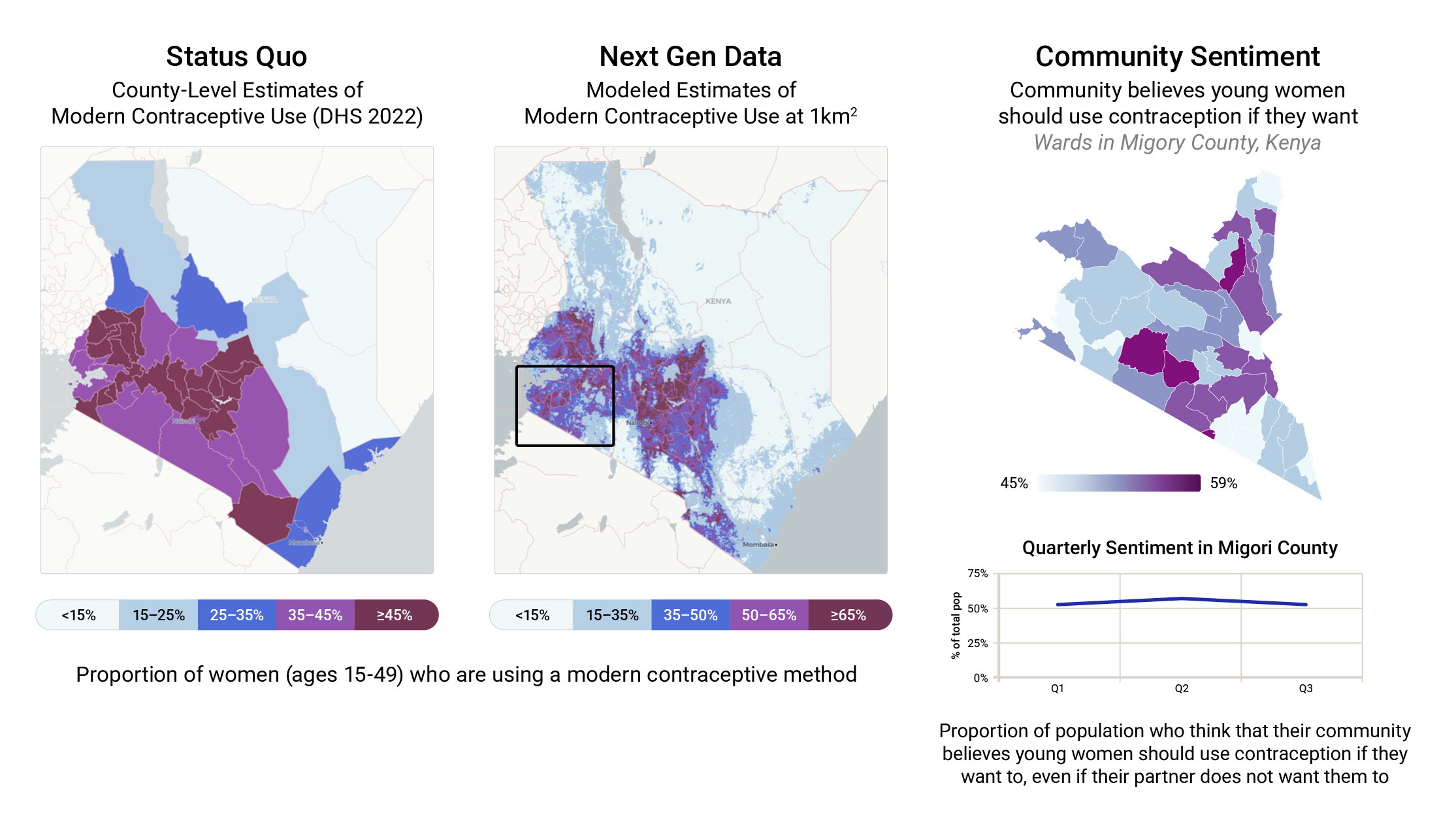
In Kenya, Fraym’s modeled estimates match DHS outputs across 29 indicators—typically within 2.4 to 6.2 percentage points at the county level.
This strong alignment holds despite differences in timing and survey mode, and despite Fraym providing estimates at 1 km² resolution, uncovering variation that broad, region-level surveys cannot.
This evidence shows that Fraym data is not simply comparable to DHS—it is a ready replacement, providing the same level of analytical confidence while enabling far more adaptive and forward-looking decision-making.
Filling the Gaps Traditional Surveys Can’t Reach
Fraym doesn’t just match the quality of DHS, its capabilities go further.
1. Hyperlocal precision that reveals what national surveys miss
Local disparities in access, trust, and behavior often determine whether programs succeed. Traditional surveys cannot reliably measure these dynamics at sub-district levels.
Fraym’s 1 km² estimates surface these patterns so teams can design with precision.2. Flexible update cycles that match the pace of real change
While a DHS typically arrives once every five years, Fraym’s tech-enabled system supports whatever refresh rate a program needs:
- Monthly updates for rapidly evolving indicators
- Quarterly updates for behavioral or access-related measures
- Annual updates for slower-moving structural indicators
This flexibility means teams can track any issue at the cadence required, no need to wait years for the next learning moment.
3. Insight into community dynamics and the social forces that shape behavior
Traditional surveys measure what people do.
Fraym also illuminates the community dynamics behind those choices, how trust, expectations, and local environments influence everything from service uptake to decision-making. These social patterns are often invisible in national datasets but critical for designing effective programs.A Modern Data System Built for Today’s Realities
Fraym fuses scientifically sampled survey data with hundreds of geospatial covariates —imagery, infrastructure, environmental characteristics — to produce validated, high-resolution estimates. Layers that do not meet strict accuracy thresholds are excluded.
The result is a flexible, resilient data system built to evolve with program needs, not constrained by legacy cycles or traditional field logistics.
What Programs Gain With a DHS Successor
By adopting a system designed for frequency, granularity, and social-context insight, teams can:
- Target precisely and act where needs are most acute
- Adapt continuously as new data signals emerging change
- Understand context through community-level behavioral and social insights
- Measure any issue at the pace required — monthly, quarterly, or annually
- Replace aging survey cycles with a more sustainable, scalable, future-ready alternative
As DHS faces an uncertain future, Fraym offers a proven, next-generation solution — one that meets today’s urgency with data designed for action.
For questions or additional information, please contact:
Melissa Persaud
VP, Growth
Email: [email protected]