Blog
29 Million Seniors Are Skipping This Season’s Flu Shot

Read More
Blog

As the November midterms approach, healthcare affordability is once again one of the most contested issues on the campaign trail. Republicans and Democrats disagree sharply on the remedies. But on the underlying question — should our government be doing something about the cost of care? — American voters have been crystal clear and deafeningly consistent in their priorities.
Yet we know surprisingly little about where those healthcare costs are biting hardest. Yes, we have lots of assumptions, proxies, and anecdotal examples. But there is no reliable neighborhood-level view of where people cite costs as actually keeping them from getting the care they need. It’s exactly the information any real reform should consider — and the picture is not what the debate assumes.
Voters’ demand for action isn’t in doubt. Over the last year, healthcare costs have ranked among the top three issues Americans want their government to tackle in more than 90% of congressional districts every single month. These aren’t temporary spikes tied to a news cycle or a political ad blitz. It’s a standing coast-to-coast declaration by voters.
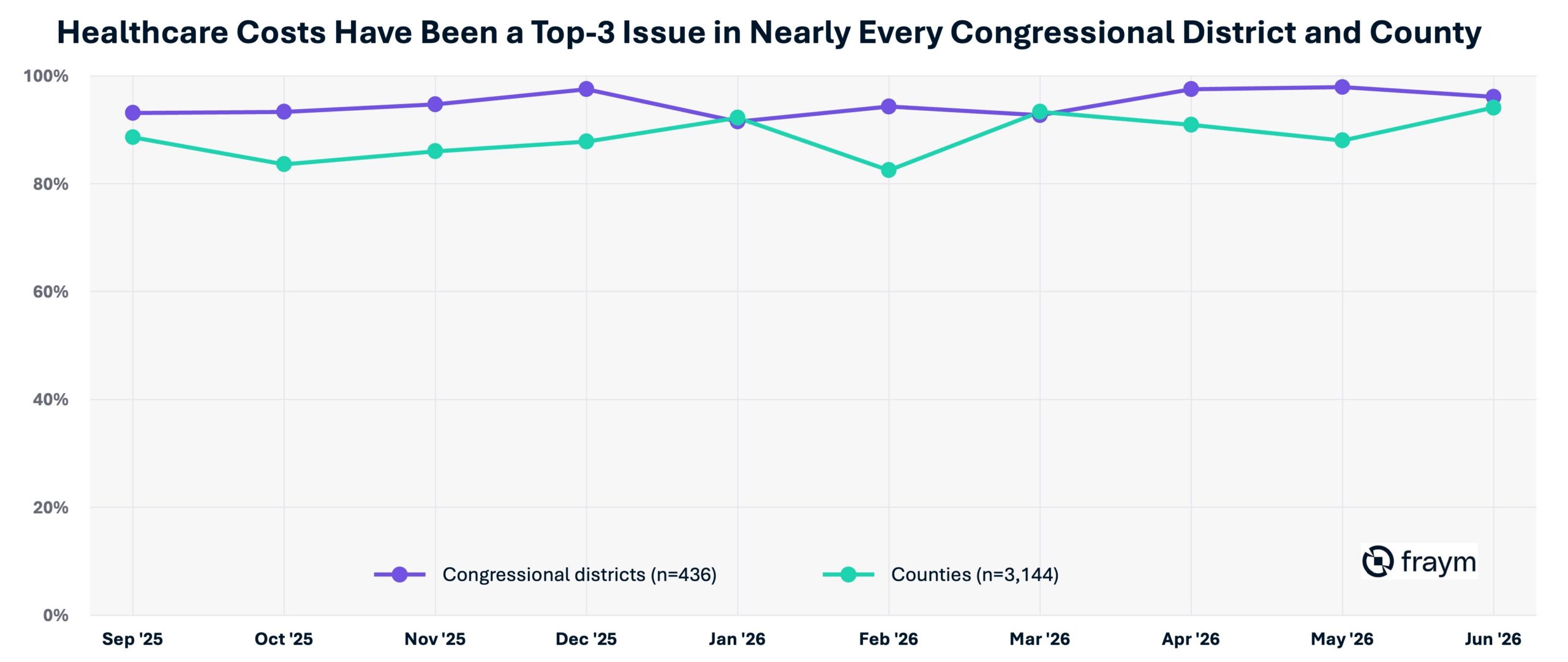
Source: Fraym data and analysis
Zoom to the county level and the concern is just as universal. In June, a majority of adults named cost a top priority in 3,083 of the country’s 3,144 counties. That’s 98 percent of U.S. counties. This is the version of the story that national and state polls tell well: a near-universal worry evenly spread across the country.
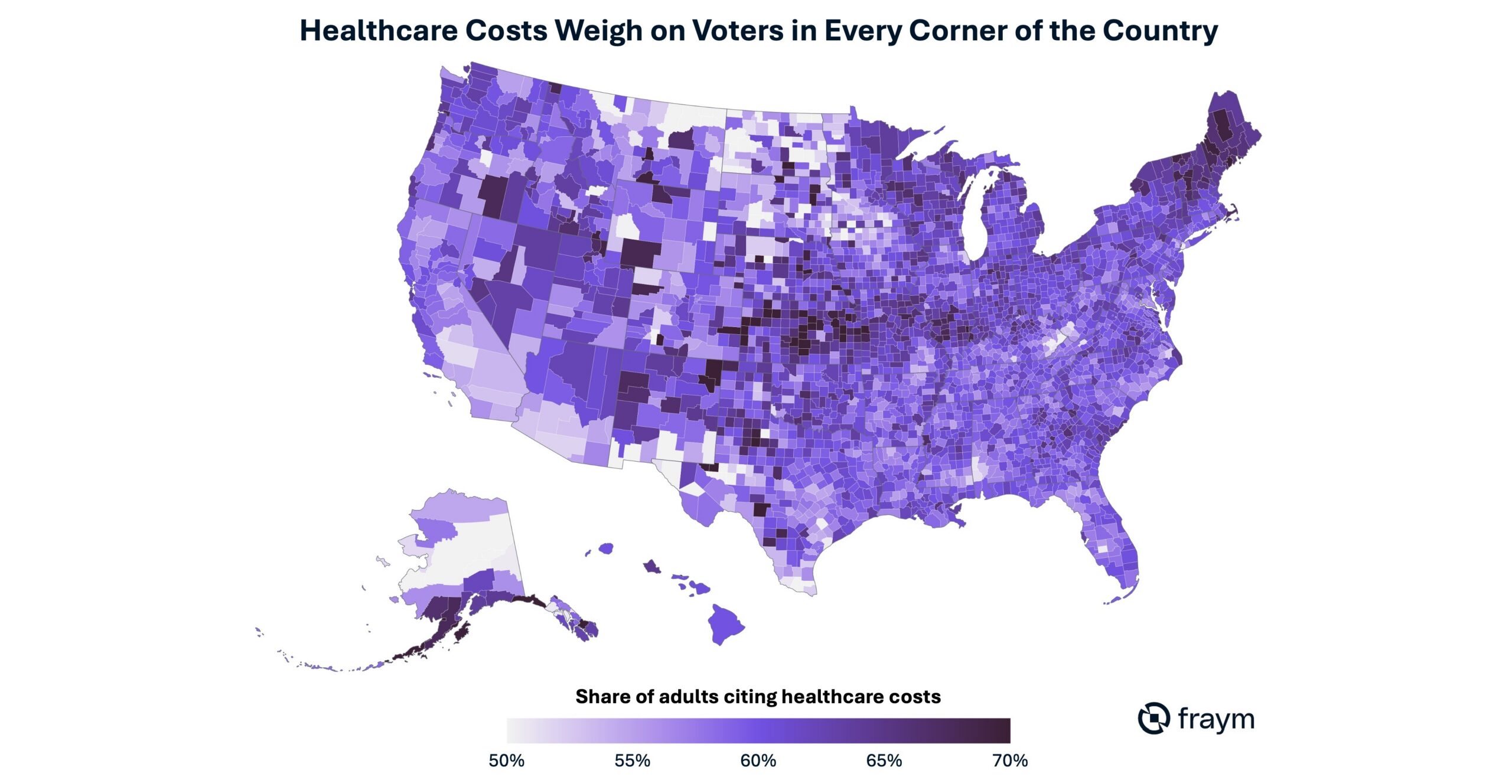
Source: Fraym data and analysis
But worrying about the cost of care and having that cost actually stop you from getting it are two very different things. The first is an opinion. The second changes what people do — the appointment they don’t schedule, the prescription they don’t fill, the specialist they never see — and, as everyone understands, it leads to worse health outcomes down the line. That second thing should matter most for policy. And it’s the one almost no one has directly measured.
So Fraym did. And that map looks very different from the first.
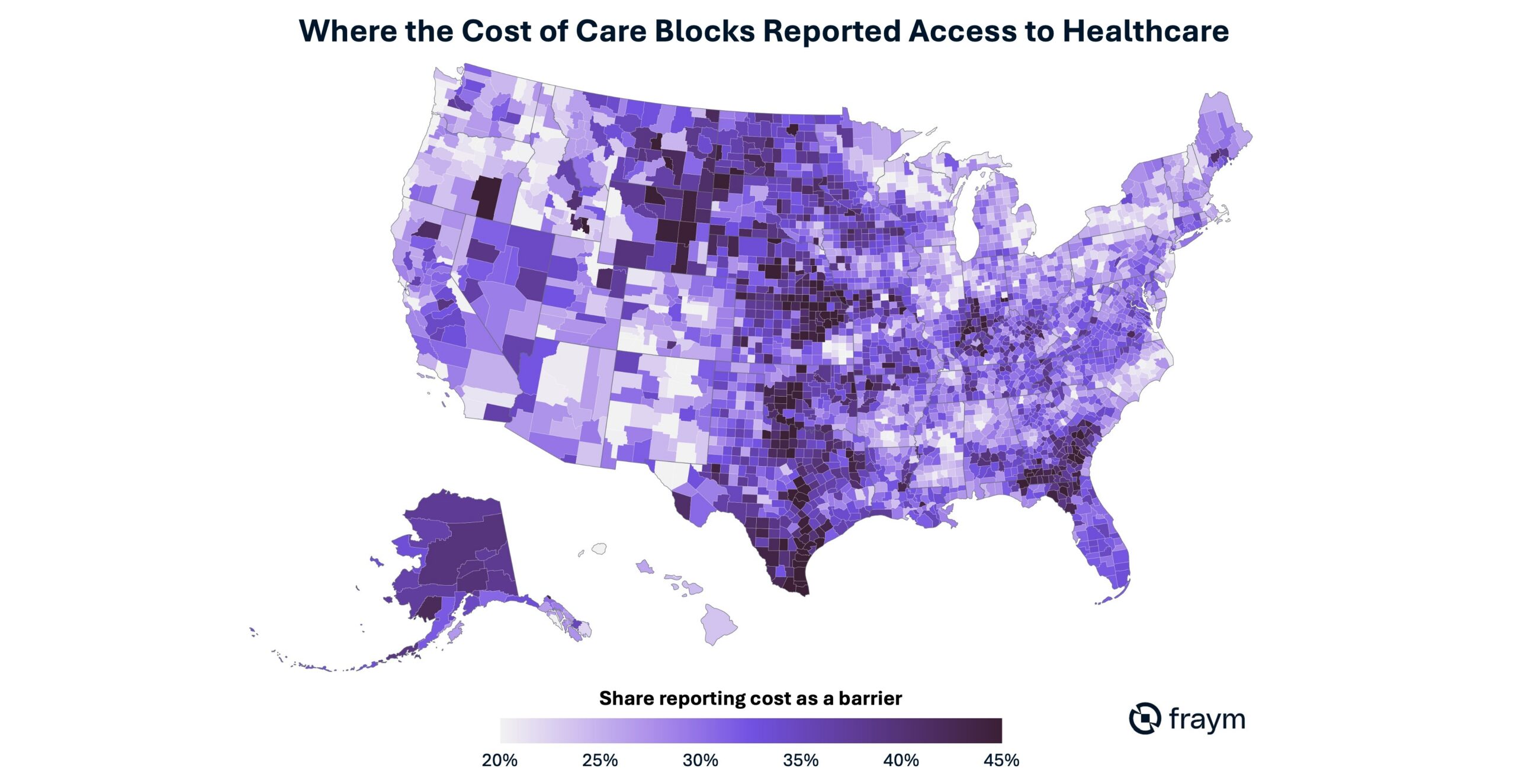
Source: Fraym data and analysis
Where people report that cost blocked their access to care, the uniformity vanishes. The barrier is concentrated in the rural South, across Texas, through the Plains, and in Appalachia. The share of adults who self-report hitting a cost wall ranges from under 10% in some counties to nearly 60% in others, with a national median of around 30%.
So, these are solely the poorest counties and those with the largest minority populations, right? Not really. Line up all 3,000-plus counties from poorest to richest quintiles and the share of residents facing a cost barrier barely moves; sort them by median income or by racial makeup and the line stays just as flat. Together, those factors explain only about 2% of where the barrier turns up, at both the county and census tract level.
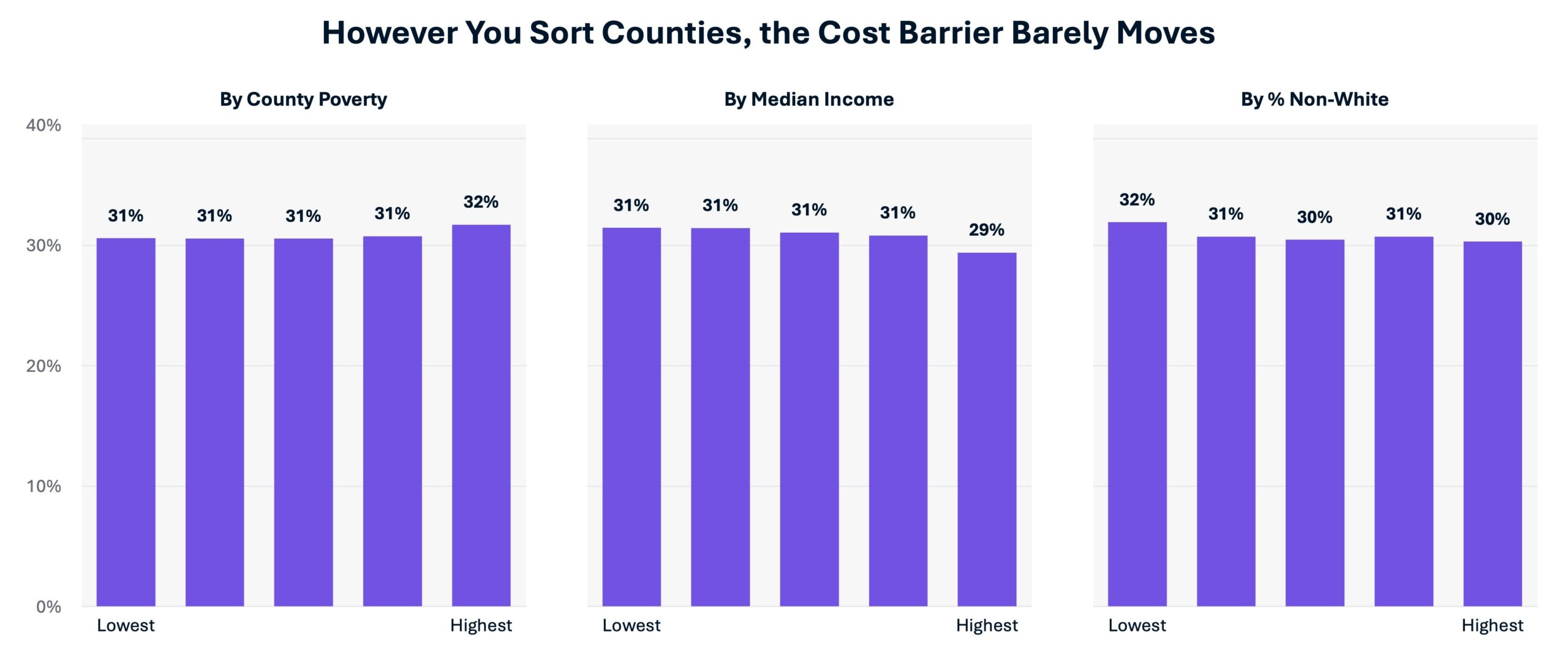
Source: Fraym data and analysis. The bar charts display the average share of county-level residents facing a cost-of-care barrier, by county grouped into quintiles (fifths) based on each factor (poverty, income, and non-white population share).
We see the same thing at the individual level. It isn’t a problem of the poor alone. In fact, it highlights a distinct middle-class squeeze. While safety-net programs cushion some lower-income households, middle-income families hit a cost wall at even higher rates, leaving only the most affluent individuals spared. Target outreach or a policy fix at the poorest or most diverse places alone, and you’ll miss much of where the problem lives.
You clearly can’t proxy these places with Census data; you have to measure the self-reported barrier directly.
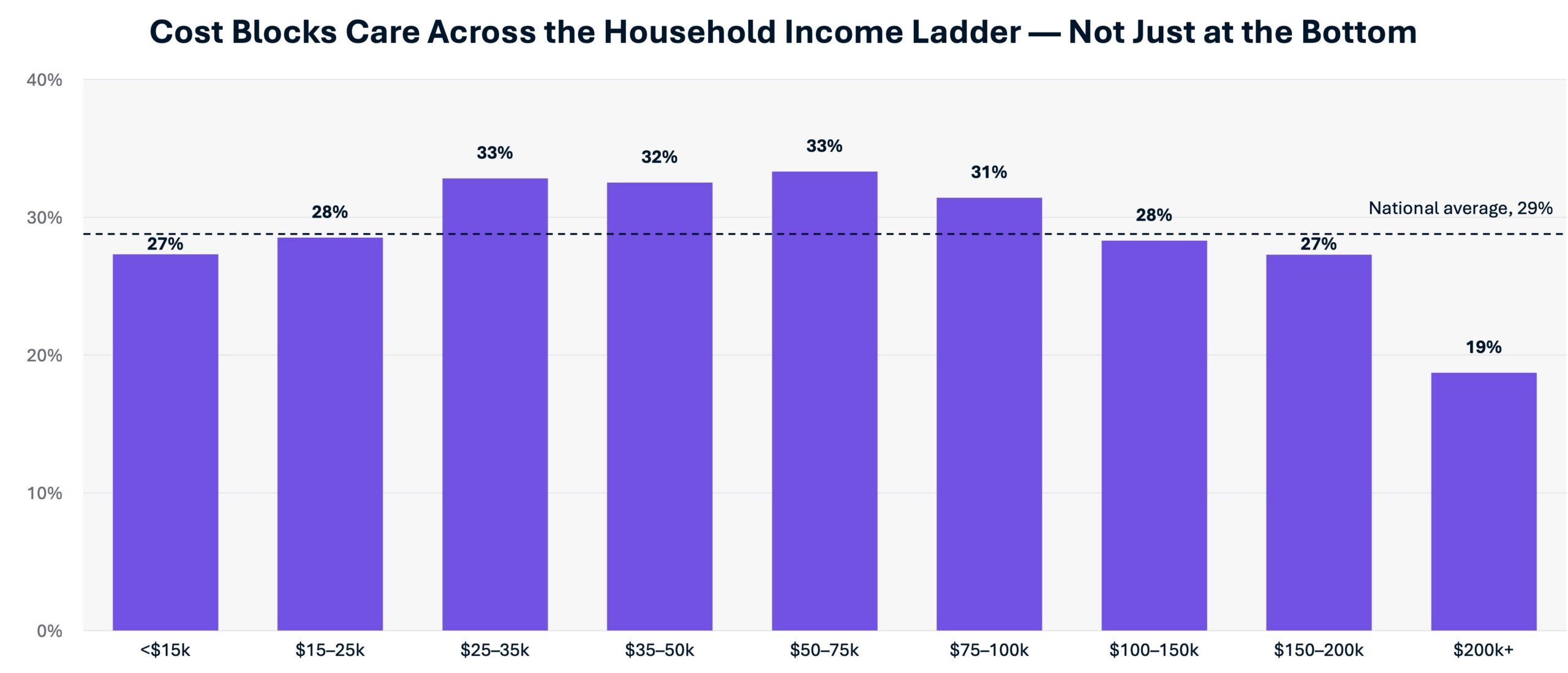
Source: Fraym data and analysis
Put the two maps together — where cost is both a top concern AND a widely reported healthcare barrier — and a specific set of places snap into focus (see dark blue below). These 981 counties are where the political salience of healthcare costs and the lived reality of how they’re blocking care converge.
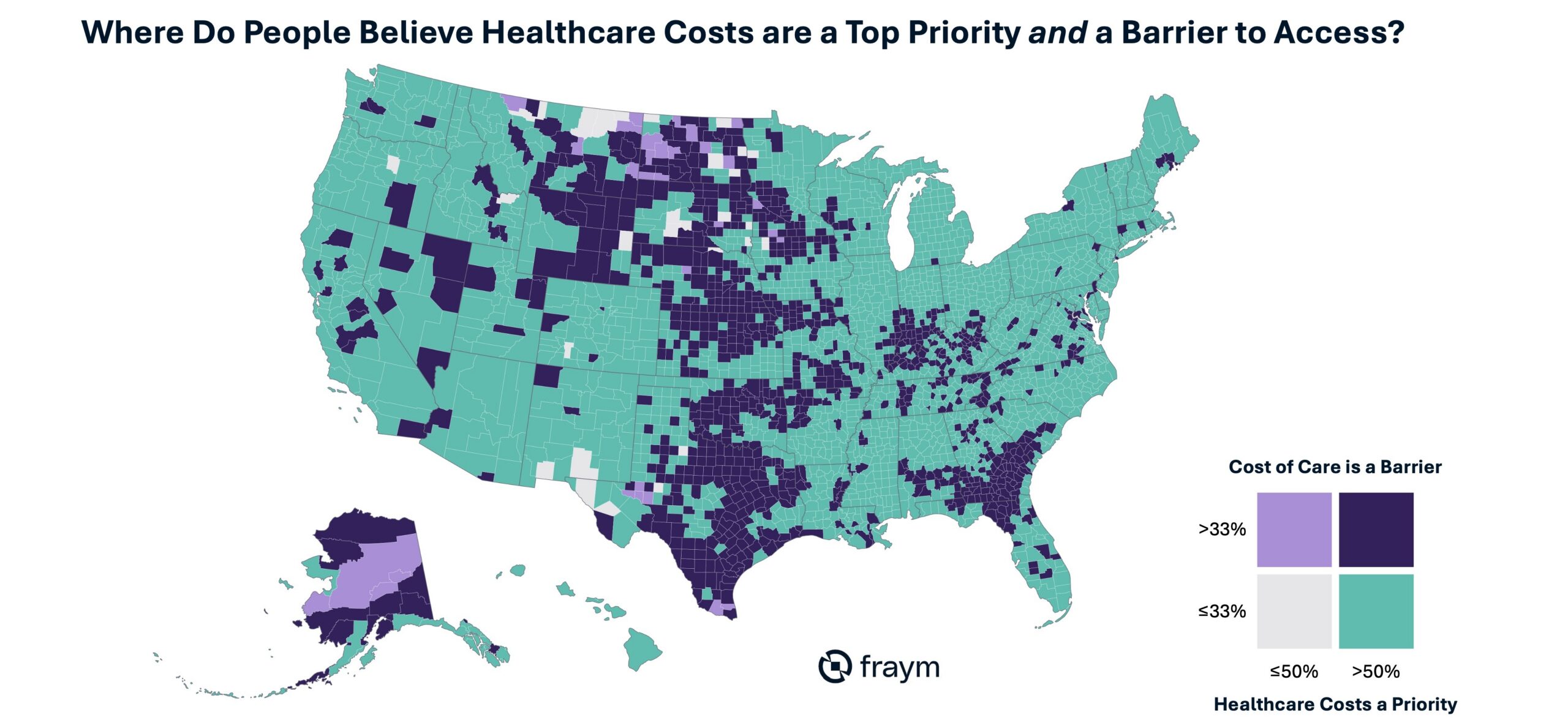
Source: Fraym data and analysis
For a family in one of these counties, healthcare costs aren’t a campaign talking point. They’re the reason a loved one’s needed appointment or procedure keeps sliding to next month.
The healthcare affordability debate will clearly run well past the midterms, with lots of twists and turns. But while the American public’s concern is nearly universal, the lived barriers are not. As such, the fixes should consider treating cost barriers the way people actually experience them — as a local, measurable problem that varies dramatically across the country.
This is exactly what we built Fraym to do. To show not just what people say they care about, but where they’re definitively held back by these same issues. And to show that for every census tract across the country.
For more information about hyperlocal healthcare data and targeting, contact Melissa Persaud at [email protected].